Someone posted this on Facebook and I was so enthralled with it that I had to re-post it here. I love researching and finding the origins of the obscure things that we say.Do you know any obscure sayings?
A Necessary Pot
They used to use urine to tan animal skins, so families used to all pee in a pot & then once a day it was taken & sold to the tannery. If you had to do this to survive you were “piss poor.”
But worse than that were the really poor folk who couldn’t even afford to buy a pot; they “didn’t have a pot to piss in” & were the lowest of the low.
Bouquet
The next time you are washing your hands & complain because the water temperature isn’t just how you like it, think about how things used to be. Here are some facts about the 1500s.
Most people got married in June because they took their yearly bath in May, and they still smelled pretty good by June. Since they were starting to smell, however, brides carried a bouquet of flowers to hide the body odor. Hence the custom today of carrying a bouquet when getting married.
Bath Water
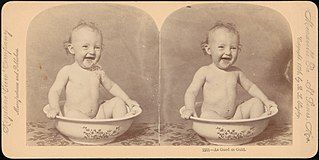
Baths consisted of a big tub filled with hot water. The man of the house had the privilege of the nice clean water, then all the other sons and men, then the women, and finally the children. Last of all the babies. By then the water was so dirty you could actually lose someone in it hence the saying, “Don’t throw the baby out with the Bath water!”
Raining
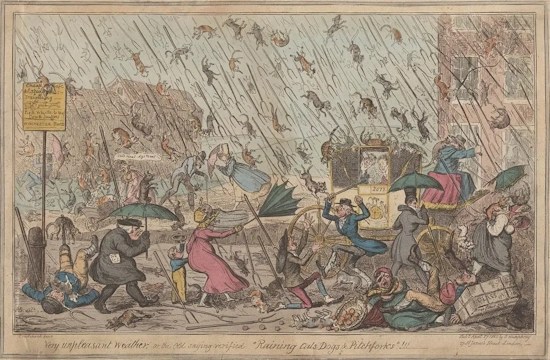
Houses had thatched roofs-thick straw-piled high, with no wood underneath. It was the only place for animals to get warm, so all the cats and other small animals (mice, bugs) lived in the roof. When it rained it became slippery and sometimes the animals would slip and fall off the roof, resulting in the idiom, “It’s raining cats and dogs.”
Canopy
There was nothing to stop things from falling into the house. This posed a real problem in the bedroom where bugs and other droppings could mess up your nice clean bed, therefore, a bed with big posts and a sheet hung over the top afforded some protection. That’s how canopy beds came into existence.
Dirt
The floor was dirt. Only the wealthy had something other than dirt, leading folks to coin the phrase “dirt poor.”
Threshold
The wealthy had slate floors that would get slippery in the winter when wet, so they spread thresh (straw) on floor to help keep their footing. As the winter wore on, they added more thresh until, when you opened the door, it would all start slipping outside. A piece of wood was placed in the entrance way, subsequently creating a “thresh hold.”
Porridge
In those old days, they cooked in the kitchen with a big kettle that always hung over the fire. Every day they lit the fire and added things to the pot. They ate mostly vegetables and did not get much meat. They would eat the stew for dinner, leaving leftovers in the pot to get cold overnight and then start over the next day. Sometimes stew had food in it that had been there for quite a while, and thus the rhyme, “Peas porridge hot, peas porridge cold, peas porridge in the pot nine days old.”
Fat
Sometimes they could obtain pork, which made them feel quite special. When visitors came over, they would hang up their bacon to show off. It was a sign of wealth that a man could, “bring home the bacon.” They would cut off a little to share with guests and would all sit around and “chew the fat.”
Crust
Those with money had plates made of pewter. Food with high acid content caused some of the lead to leach onto the food, causing lead poisoning death. This happened most often with tomatoes, so for the next 400 years or so, tomatoes were considered poisonous.
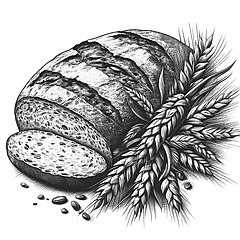
Bread was divided according to status. Workers got the burnt bottom of the loaf, the family got the middle, and guests got the top, or the “upper crust.”
Wake Up
Lead cups were used to drink ale or whisky. The combination would sometimes knock the imbibers out for a couple of days. Someone walking along the road would take them for dead and prepare them for burial. They were laid out on the kitchen table for a couple of days and the family would gather around and eat and drink and wait and see if they would wake up, creating the custom of holding a wake.
Saved
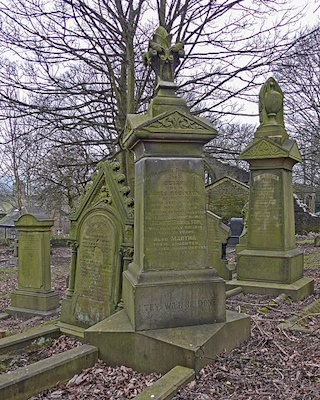
England is old and small, and the local folks started running out of places to bury people. So they would dig up coffins and would take the bones to a bone-house, and reuse the grave. When reopening these coffins, 1 out of 25 coffins were found to have scratch marks on the inside and they realized they had been burying people alive, so they would tie a string on the wrist of the corpse, lead it through the coffin and up through the ground and tie it to a bell. Someone would have to sit out in the graveyard all night (the graveyard shift.) to listen for the bell; thus, someone could be saved by the bell or was considered a dead ringer.
An excerpt from my story about growing up in Central Iowa in the 50s
The Great Outdoors in Marshall County
We spend all our time outdoors unless it’s really bad weather. The only time we are indoors is when it’s crazy hot and humid, a howling blizzard or a thunderstorm with a tornado in it. In hot, humid weather my refuge is our finished basement where there is a wall of shelves stacked with hundreds of Life magazines that mom has saved ever since the first issue came out. It’s cool like a cave in the basement in the summer and I must have gone cover to cover in every single one of those magazines she had. Later on when I became a graphic designer the innovative Life magazine picture centered layout inspired me and was my main stay. This was in the day before central air conditioning so the coolness of the basement is a god-send. In the winter we play outside in any weather except blizzards. We build snow forts and lob snowballs at each other or dig out snow caves from the drifts and pretend we are eskimos. We even brought food to snack on in our caves. We made snow angels in the snow and rolled the snow into snowmen and snow creatures. Being outside in all seasons was neither here nor there for us. We didn’t think about it. It was just what we did and what was expected of us.
Sometimes after a cloudburst thunderstorm, the storm drain on the street in front of our house would clog with debris and back up into the street and form a little lake. Mom would let us go out and ride our bikes through it. You heard thunder off in the distance from the receding dark rain cloud that was still close enough and the air would be humid and cool. This was great fun.
In the summer we went to the outdoor municipal pool at Riverview Park. It was there that I learned to swim but not to jump off the dive board. I did that once and only once because when I got my nerve up and tried it my stomach leaped into my throat. It wasn’t such a high diving board, maybe 10 feet or so but it seemed high enough to me and that scared me to death, so I never did it that again. We ate salty popcorn from the snack bar and fudgsicles that would melt if you didn’t eat them real fast. I had a gap between my two front teeth and I would take a mouthful of pool water (!!!) and squirt a stream of water at my friends.
In the back yard we played Annie Over which was a game of throwing a ball over the roof of our garage to our friends on the other side. This is how it went: we’d yell Annie Over! and throw the ball as hard as we could. One of two things would then happen, and you never knew what it would be and that’s what made the game exciting. First, the friend on the other side would not know where the ball was coming from. They would either get lucky and it would, by some miracle, come straight to them and they could catch it or it wouldn’t, and they would have to run to get it wherever it came down. If they caught it, they were allowed to run around the end of the garage and try to tag us with the ball. This was a game of honesty. Fair and square. We didn’t ever consider faking it or at least I never did. So, when we threw the ball, we had to then be on the ready to see if our friend would come tearing around the side of the garage and get us. If they didn’t catch it, then they were to yell Annie Over! and throw the ball back to us. There would be a pause where uncertainty prevailed and nothing was happening. It was a nerve-wracking game but fun.
We also played jacks and pick up sticks. Jacks is where you had a little rubber ball or sometimes a golf ball and a bunch of metal objects that looked liked pronged stars. They were tiny. Maybe the size of a nickle. You’d trow the ball lightly in the air and let it bounce once and then you had a chance to pick up as many jacks as you could before the ball hit again. Pick up sticks was similar. You had a bundle of thin sticks that you would let fall into a heap and then taking one of the sticks peel the other sticks away and not move any of the others. If you moved any you were out and your partner had a chance. If you were very very good you might be able to peel away all of the sticks and this made you King of the World and you won the game. If you couldn’t and you kept trading turns back and forth. Whoever had the last try was the winner. I was very good at both because of my steady hands, and ability to keep my eye on the ball, with quick reflexes. Hopscotch was improved after we figured out that we could use little ball chains that were better at landing and staying on the square than the average rock which invariably skittered off. We lived each summer on the shady side of the porch or on the sidewalk.
We skated up and down the newly paved roads and sidewalks of our modest subdivision in the kind of skates that attach to your shoes with clamps. A little key tightened the clamps on the skates to your shoes. It was a good thing that our roads were pretty new with very few bumps and ruttles. Even so someone would always come home with a bad case of road rash. Skinned knees were common.
We learned bike riding from our dads who ran with us holding on to the seat while we pedaled as if our little lives depended on it. All of a sudden, the dad would yell, “You’re on your own!” and we’d be flying!
In winter the guy who ran the tiny neighborhood grocery store and bakery down on Nevada Street scooped out a large shallow area in the empty lot next to his store and filled it with water after the weather was good and cold. The ice wasn’t smooth, so I never did well at skating. I fell more than anything else. Sometimes mom and dad would take us to the country club where they had acres of rolling hills devoid of trees and bushes and covered with snow and not so deep so a kid could use their toboggan, inner tube or Flexible Flyer and go screaming down the hill careful to miss the tiny creek covered with snow at the bottom.
From left: In the back silhouetted our dog Heidi (a Weimaraner) my sister Toni, my mom, and me.
In spring after a hard rain, I would go with my dad to look for arrowheads in the plowed fields. It had to be after a hard rain so the arrowheads would be washed clean and stand out from the dirt. My dad would say, “Look for something that doesn’t fit.” When he found something, he’d say, “It fascinates me that the last person to hold this was the person who made it.” (an Indian, of course) Because the fields were wet and muddy, we’d be tromping around in heavy boots weighed down by elephant size globs of mud but that was not a problem. Sometimes a hawk would circle overhead, and I figured out how to whistle like a hawk and if the hawk whistled back, I was 100% convinced that we were communicating. The sky would be blue and clear except for the small cumulus clouds that scudded over head in the breeze coming in from the north over the Great Plains. I was in my element.
Entertainment
Saturday mornings were for cartoons. The folks were asleep when we kids got up as soon as the cartoons started which was about 7 or 7:30 am and then we’d marathon watch Heckle and Jeckle, Mighty Mouse, Tom and Jerry, Bugs Bunny, and Rocky and Bullwinkle. Then there was Sky King, Roy Rogers, Fury the Wonder Horse as well as My Friend Flicka. That show didn’t start until I was older. We didn’t have a TV until I was about 10 and then it was black and white. I watched the Beatles on The Ed Sullivan Show when I was 13 on a black and white TV. Color came when I was in high school.
I got a small record player for Christmas that played 33/45/78 rpm records. We had that record player a long time and when I got older I had a My Fair Lady album with all the show tunes, and I sang along. Somehow, I learned the words to Wouldn’t it be Loverly? I loved Johnny Horton singing North to Alaska and Gene Pitney singing The Man Who Shot Liberty Valance. OK, so it was cornball.
Speaking of cornball, I would go over to Jamie’s house to their finished basement where she tried in vain to teach me how to dance while her record played the latest tunes. She tried to teach me to do the Mashed Potato and the Locomotion, which was a line dance. Everybody’s doing a brand-new dance, now, c’mon baby, do the locomotion! Talk about two left feet. I really wanted to dance well. I was like a colt all arms and legs tangled up. I didn’t really learn to dance until years later when I was in college! I finally stopped being self-conscious.
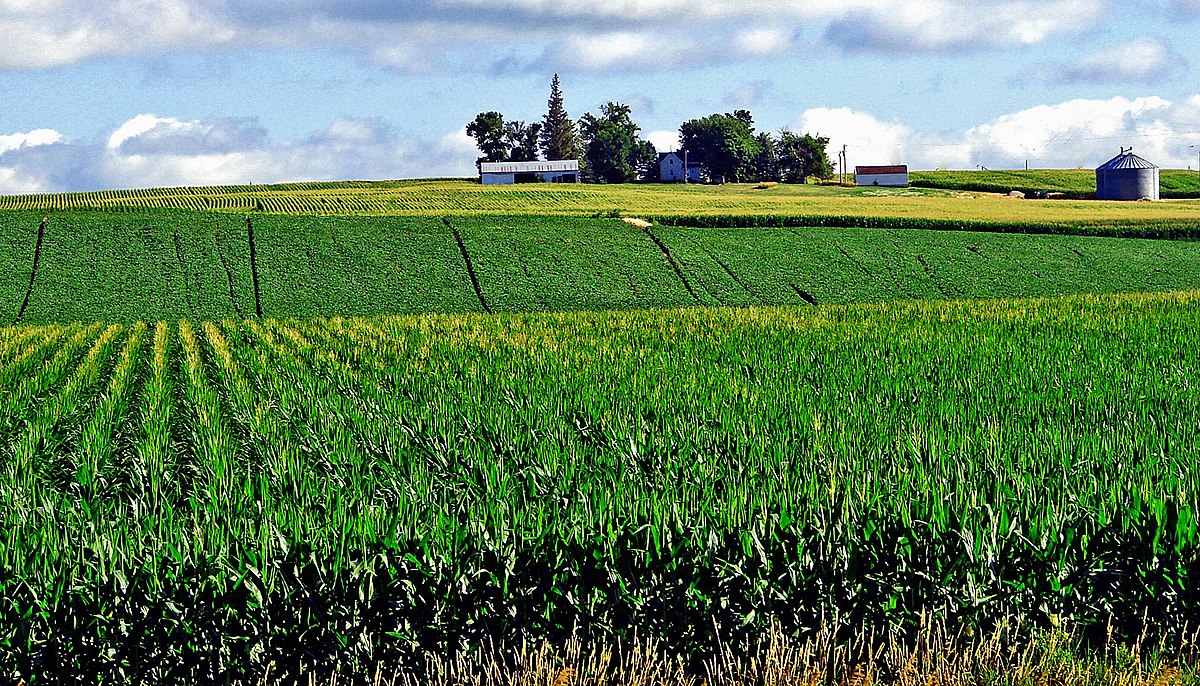
On weekends we would beg for Dad to take us to Polley’s farm north of town so we could ride out through the cornfield stubble to the timber on Al’s barn sour horses. Some young women would saddle the horses for us, cussing at the horses all the while. Maybe they were Al’s daughters, who knows? I never heard such language in our prim and proper household. Swearing was not allowed in our house but swearing was allowed at Al’s. We rode western saddles and I tried to copy how my dad neck reined one hand on the reins and one hand on his hip. We’d ride through the timber looking for deer sign because this was where my dad did most of his hunting. Then we’d go through a break in the trees and the horses got the barn in their sights. The horses always took off while we clung to the saddle horns for dear life laughing our stupid heads off.
In the same timber we’d go for winter cook outs in the snow. Dad and his friends had what they called The Deer Shack. It was an A frame plywood shack that they went in to get warm after sitting in a tree stand waiting for hours for a deer to come along on a well worn path in winter. Their deer hunting days were in November so you know it was cold. Sitting up in the tree on a little board for your perch was the only way to get a deer if you could get one at all. They didn’t have big high-powered rifles with scopes. Just ordinary recurve bows. They fletched their own arrows, too. Anyway, there was so much underbrush that stalking the deer on the ground would have been an exercise in futility. The deer could hear you coming a mile away. At the deer shack the moms brought homemade chili and the dads would build a big fire and when the coals were hot, we’d warm that chili up and eat it with saltine crackers.
Weather
Every summer we would have terrible thunderstorms where wind, thunder and lightning was beyond the beyond. If a storm happened at night, we’d watch the light show from the safety of our house but always be on the ready to dash to the basement. The lightning fascinated me, but the thunder was bad and hurt my ears. There would be the crack of the lightning and simultaneously there would be the tremendous clap of thunder and the house and windows literally shook. Our Weimaraner dog whimpered and cried while she hid under our beds. I didn’t blame her one bit. Sometimes there would be a tornado alert and mom would tell us all to get to the basement. She was of the opinion that if we sheltered in the southwest corner of the basement that the house, if hit, would fall away from us. She also was pretty confident that Marshalltown would never get a direct hit because the Indian lore she heard said that encampments built where two conjoining rivers were safe. We had Linn Creek (pronounced “crick”) that ran through town and flowed into the Iowa River on the town’s northeastern part.
She also said that we were to open windows on the side of the house facing away from the direction where the storm was coming because she claimed that would equalize the pressure inside the house and the house wouldn’t explode apart. It turned out that all the things she said were untrue and unscientific but at the time I really believed her and somehow we managed to stay safe. Nothing ever happened. Years later, though, a tornado tore through the middle of Marshalltown, straight down Main Street, so the truth came out. Marshalltown was indeed vulnerable all along.
The green indicates that there is a lot of hail in the cloud. Hail reflects back green on the light spectrum. So, sorry, corn plants. You are about to be shredded.This is a really intense green so I think the photo was a bit doctored.
Growing up in Iowa gave me a great respect, interest and understanding of weather. On sultry summer days you could expect that by late afternoon there would be some kind of thunderstorm. Large or small, you never knew. Here would come the great shelf cloud from the west. You could see it coming for miles. The main event of the storm, the thunderhead, was many miles high, maybe even 5 miles, and the shelf cloud in front and below the advancing storm would be a creepy shade of green. All was ominously still and silent before the storm, and then the gust front hit! All hell would break loose! The rain came down in great sheets and giant drops. The wind could blow the small trees almost to the ground and branches were blown off the big trees. Once we were looking up into the storm clouds and I saw several tiny little tornados way up high. In Illinois while visiting my grandmother there was the unmistakable funnel cloud miles away silhouetted black against the western sky at the edge of the storm. Since then, I’ve always loved weather and clouds and am bored if it’s the same all the time.
Here it comes. This is exactly how it looks. And the air has a quality that cannot be described in words but I’ll try. Silent. Still. Ominous. You have to experience it to know exactly what it’s like.
My favorite time of year was fall. By fall the Iowa River would be very low and almost but not quite dried up. We would drive north out of town to Timmons Grove Park, walk down to the water and wade for miles up the middle. We might also bring truck tire inner tubes that we got from a tire repair place and float downstream. If we were wading Dad always said avoid the downstream end of the sand bar where the water was deepest because the sand was soft there and could suck your foot down and you’d sink in. The rest of the river was no deeper than your calf and easy walking. We’d keep our eyes peeled for river clams and when we found a bunch, we’d take them home in a bucket of river water and then leave them alone until their foot came out looking for food. They were big and heavy and no one ever ate them. Buttons were made from their shells in the olden days.
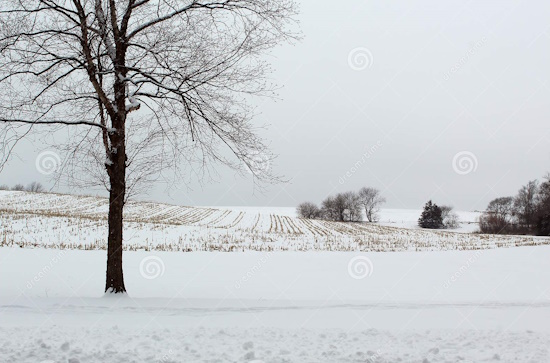
Winter was beasty cold and windy and most of the time there was very little snow. It seems like it just blew away. The scene you saw out your window was all monochromatic shades of white, gray and black occasionally punctuated by a dark green evergreen tree. The evergreen would be the only color. The fields were white. The trunks of the trees were black. The snow, if there was any, was dirty and unappealing, The sky was depressingly gray because it was almost always clouded over from horizon to horizon with low clouds of no texture. Just a blanket of gray the same color as the ground. The only time the sky was clear was after a cold front that came in from Canada and then it would be bitterly cold.
Sometimes there would be an ice storm which we kids loved. School would be closed because it was treacherous to drive. Everything would be covered in ice. I mean everything. The tree branches and electric wires would be bending down to the ground looking like they would snap any minute and sometimes they did. We got out our ice skates and would skate all over. There wasn’t anything not to like about it. Beautiful but dangerous.







 R L Benoit - Writer/Artist