An excerpt from “Just Walk Away – A remembrance of growing up in the 50s in Central Iowa”
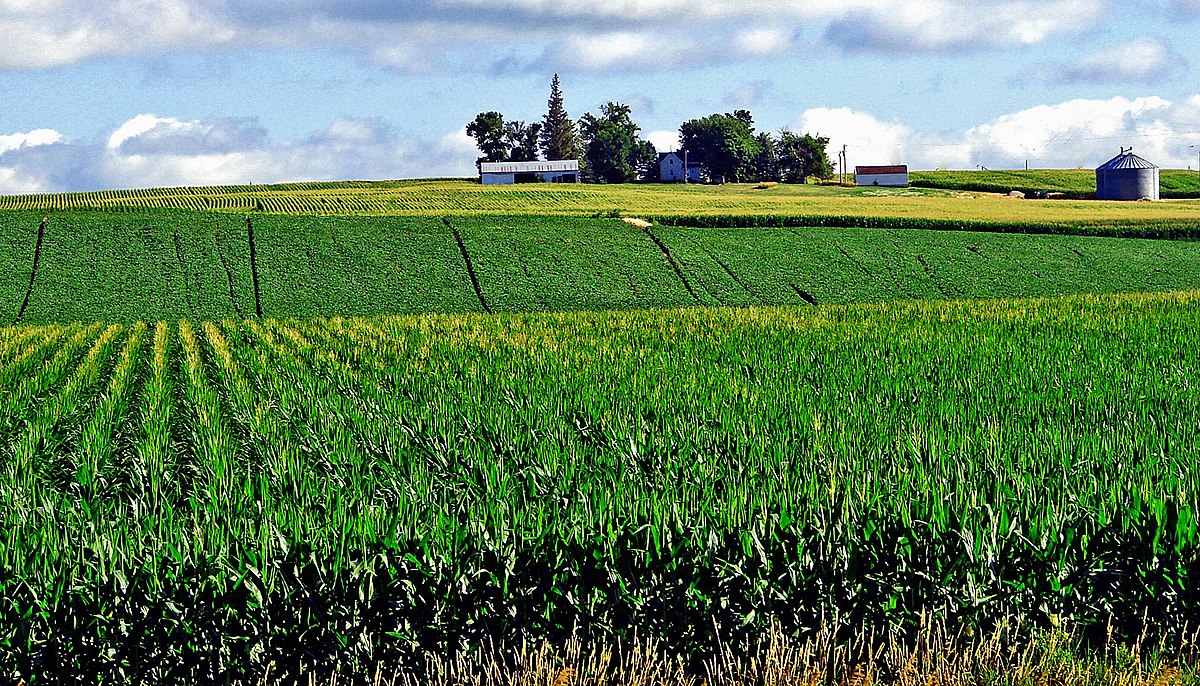
This is the old Glick Elementary School in Marshalltown, Iowa
I started school when I was four years old. Because I was the oldest, I always got to be the first one to test the waters for everything that the kids in our household had to do. I thought this was a rip off and unfair as the dickens. Maybe they were trying to get rid of me sooner but in reality they probably thought I could handle it and I could.
I started kindergarten at age 4 because I would not be five until October and school started in September. Norris Elementary was easy walking distance from our house but at first my mom walked with me and then because there were so many kids in the neighborhood the same age and going to the same place all at one time we walked on our own. I thought kindergarten was pretty cool. It seemed like all we had to do was play. For example, we made puppets out of shoe boxes and paper sacks and one boy had us screaming with laughter when he made his puppet’s head shoot up out of the shoe box body and fly across the room.
First grade was pretty much the same as kindergarten, and certainly we started to learn to read and practice rudimentary arithmetic. You know, one plus one equals two and that sort of thing. I don’t remember any of that although I can now read really well, and have been able to for a long time, plus I can also do arithmetic with the best of them so they did their job. What I do remember is the teacher filled a large jar with milk which we passed around to each other each taking a turn at shaking until the butter separated out from the buttermilk. We then ate the butter on crackers, and it was absolutely delicious! The beginnings of my interest in good fresh homemade food.
My favorite teacher was the 3rd grade teacher Shirley Knoll who taught us the “La Cucaracha” song. La Cucaracha mentioned marijuana and I don’t know if Miss Knoll knew this, but she explained to us it was just a cigarette.
“La cucaracha, la cucaracha
Ya no puede caminar
Porque no tiene, porque le falta
Marijuana que fumar!”
“The cockroach, the cockroach
Can’t walk anymore
because he doesn’t have it, because he lacks it,
marijuana to smoke.”
(Exposed to vice at an early age.)
She also had us make up pen names and write short stories. I chose the pen name Miss Ster because I couldn’t think of anything and like a little criminal, I peeked over to see what John, who sat across the aisle, had chosen. He had chosen Dr. Sterling. I thought in my little pea brain third grade mind, “That sounds good.” So, I took that inspiration and came up with the name “Miss Ster”. Later I was surprised to have Miss Knoll tell me how clever I was. It took me a while to understand what she meant and I didn’t get that I had chosen “mister” (Miss Ster). She set me up for a lifetime of enjoying the process of writing even if it was somewhat based on thievery. I’ll never forget her.
“Ha! Happy Go Lucky Ha!!! Stories” written and illustrated by Miss Ster
Norris was kindergarten through the third grade so when it came time to go higher, we all got on our bikes and went to Woodbury school which was a few blocks from downtown.
See the metal lunch box in the bike basket? It looks like a house. Saddle shoes. Ill-fitting sweater! Wrinkly old skirt.
Most of the time we rode our bikes to Woodbury. It would be a caravan of about 8 girls from the neighborhood meeting up and setting off without parental supervision. It wasn’t like today where kids seem to need parental supervision for just about everything. Jamie, Patty, Marjorie, Sally, my sister, Cindy, Pat, and me. Where were all the boys? We didn’t seem to have many in our neighborhood. Cindy had 2 younger brothers. Maggie had one brother and, of course, Toni and I had our brother. It was a girl dominated neighborhood!
If the weather was bad, one of the moms took us to school in a car. They’d cram all those kids in the front and back seat of a 1955 two door sedan. We’d be sitting staggered, one up and one back, to make us all fit in. Seat belts did not exist or if they did no one used them and would not have worried about it. No one cared that the seating arrangement was not safe in case of an accident. We survived and things have changed.
This wasn’t our car. I don’t remember how ours looked but this is close.
I don’t recollect much about 4th, 5th and 6th grade except that Miss Ward read us thrilling stories after lunch (“The Lion’s Paw” and “Around the World in Eighty Days”) and that my 6th grade teacher Mr. Melvin Peed was so good looking! My mom decided I needed to learn a musical instrument, so she got me a rented violin from Smith Music Company, and I toted that heavy awful thing up to Miller Junior High where Mr. Fowler, the music teacher, tried to teach us something. I was bad. Let’s just say that. I sort of learned the basics of a French song “Au Claire de la Lune”. Screech schreech screech screech, schreech schreech. That was a disaster, so we got a piano. The violin was out. The whole family drove to Des Moines and shopped for a brand new piano at Baldwin Piano company. We got a spinet, and it had a beautiful tone. I took lessons from Miss Jackson in the basement of the one and only music store in town. I’ll never forget how that store smelled. All those amazing instruments and the sheet music! It was glorious. As for the piano, when I wasn’t practicing in the grumpiest way imaginable and lying about how much I had practiced, mom would get on it and play her German kind of oompa music. Dad would sing along sometimes. He had a pretty good voice. You know they both could sing pretty well. I wish I had had foresight because now I would love to be able to play. Isn’t that how it goes sometimes? I can hear myself warning my daughter, “You’re going to regret it someday if you don’t learn to pay that cello!” Typical.
This isn’t me but it could have been. It’s a Baldwin Acrosonic just like we had.
The best thing about the piano was that it came in a great big wooden crate that we kids decided was perfect to make a computer out of. Big main frame computers were just coming in and somehow, we heard about them. Maybe I read about them in one of the, what seemed like, one million LIFE magazines Mom had stored downstairs. We cut a couple holes in the piano crate and labeled them “IN” and “OUT”. Then we decorated the outside to make it look like what we thought a computer looked like. When it was ready my sister got inside the crate with a vacuum cleaner and a typewriter. Then we invited the neighbor kids to ask it a question. To do so you would write the question on a piece of paper and insert the paper in the “IN” slot. The vacuum cleaner we installed inside the box would be switched on to indicate something was happening noisily inside the computer (it was WORKING, ya know!), and sister would type an answer on the old Smith Corona typewriter and put it out the “Out” hole and switch off the vacuum cleaner.
And to think a lot of today’s kids can’t come up with a way to entertain themselves without the aid of a screen.
An excerpt from my story about growing up in Central Iowa in the 50s
The Great Outdoors in Marshall County
We spend all our time outdoors unless it’s really bad weather. The only time we are indoors is when it’s crazy hot and humid, a howling blizzard or a thunderstorm with a tornado in it. In hot, humid weather my refuge is our finished basement where there is a wall of shelves stacked with hundreds of Life magazines that mom has saved ever since the first issue came out. It’s cool like a cave in the basement in the summer and I must have gone cover to cover in every single one of those magazines she had. Later on when I became a graphic designer the innovative Life magazine picture centered layout inspired me and was my main stay. This was in the day before central air conditioning so the coolness of the basement is a god-send. In the winter we play outside in any weather except blizzards. We build snow forts and lob snowballs at each other or dig out snow caves from the drifts and pretend we are eskimos. We even brought food to snack on in our caves. We made snow angels in the snow and rolled the snow into snowmen and snow creatures. Being outside in all seasons was neither here nor there for us. We didn’t think about it. It was just what we did and what was expected of us.
Sometimes after a cloudburst thunderstorm, the storm drain on the street in front of our house would clog with debris and back up into the street and form a little lake. Mom would let us go out and ride our bikes through it. You heard thunder off in the distance from the receding dark rain cloud that was still close enough and the air would be humid and cool. This was great fun.
In the summer we went to the outdoor municipal pool at Riverview Park. It was there that I learned to swim but not to jump off the dive board. I did that once and only once because when I got my nerve up and tried it my stomach leaped into my throat. It wasn’t such a high diving board, maybe 10 feet or so but it seemed high enough to me and that scared me to death, so I never did it that again. We ate salty popcorn from the snack bar and fudgsicles that would melt if you didn’t eat them real fast. I had a gap between my two front teeth and I would take a mouthful of pool water (!!!) and squirt a stream of water at my friends.
In the back yard we played Annie Over which was a game of throwing a ball over the roof of our garage to our friends on the other side. This is how it went: we’d yell Annie Over! and throw the ball as hard as we could. One of two things would then happen, and you never knew what it would be and that’s what made the game exciting. First, the friend on the other side would not know where the ball was coming from. They would either get lucky and it would, by some miracle, come straight to them and they could catch it or it wouldn’t, and they would have to run to get it wherever it came down. If they caught it, they were allowed to run around the end of the garage and try to tag us with the ball. This was a game of honesty. Fair and square. We didn’t ever consider faking it or at least I never did. So, when we threw the ball, we had to then be on the ready to see if our friend would come tearing around the side of the garage and get us. If they didn’t catch it, then they were to yell Annie Over! and throw the ball back to us. There would be a pause where uncertainty prevailed and nothing was happening. It was a nerve-wracking game but fun.
We also played jacks and pick up sticks. Jacks is where you had a little rubber ball or sometimes a golf ball and a bunch of metal objects that looked liked pronged stars. They were tiny. Maybe the size of a nickle. You’d trow the ball lightly in the air and let it bounce once and then you had a chance to pick up as many jacks as you could before the ball hit again. Pick up sticks was similar. You had a bundle of thin sticks that you would let fall into a heap and then taking one of the sticks peel the other sticks away and not move any of the others. If you moved any you were out and your partner had a chance. If you were very very good you might be able to peel away all of the sticks and this made you King of the World and you won the game. If you couldn’t and you kept trading turns back and forth. Whoever had the last try was the winner. I was very good at both because of my steady hands, and ability to keep my eye on the ball, with quick reflexes. Hopscotch was improved after we figured out that we could use little ball chains that were better at landing and staying on the square than the average rock which invariably skittered off. We lived each summer on the shady side of the porch or on the sidewalk.
We skated up and down the newly paved roads and sidewalks of our modest subdivision in the kind of skates that attach to your shoes with clamps. A little key tightened the clamps on the skates to your shoes. It was a good thing that our roads were pretty new with very few bumps and ruttles. Even so someone would always come home with a bad case of road rash. Skinned knees were common.
We learned bike riding from our dads who ran with us holding on to the seat while we pedaled as if our little lives depended on it. All of a sudden, the dad would yell, “You’re on your own!” and we’d be flying!
In winter the guy who ran the tiny neighborhood grocery store and bakery down on Nevada Street scooped out a large shallow area in the empty lot next to his store and filled it with water after the weather was good and cold. The ice wasn’t smooth, so I never did well at skating. I fell more than anything else. Sometimes mom and dad would take us to the country club where they had acres of rolling hills devoid of trees and bushes and covered with snow and not so deep so a kid could use their toboggan, inner tube or Flexible Flyer and go screaming down the hill careful to miss the tiny creek covered with snow at the bottom.
From left: In the back silhouetted our dog Heidi (a Weimaraner) my sister Toni, my mom, and me.
In spring after a hard rain, I would go with my dad to look for arrowheads in the plowed fields. It had to be after a hard rain so the arrowheads would be washed clean and stand out from the dirt. My dad would say, “Look for something that doesn’t fit.” When he found something, he’d say, “It fascinates me that the last person to hold this was the person who made it.” (an Indian, of course) Because the fields were wet and muddy, we’d be tromping around in heavy boots weighed down by elephant size globs of mud but that was not a problem. Sometimes a hawk would circle overhead, and I figured out how to whistle like a hawk and if the hawk whistled back, I was 100% convinced that we were communicating. The sky would be blue and clear except for the small cumulus clouds that scudded over head in the breeze coming in from the north over the Great Plains. I was in my element.
Entertainment
Saturday mornings were for cartoons. The folks were asleep when we kids got up as soon as the cartoons started which was about 7 or 7:30 am and then we’d marathon watch Heckle and Jeckle, Mighty Mouse, Tom and Jerry, Bugs Bunny, and Rocky and Bullwinkle. Then there was Sky King, Roy Rogers, Fury the Wonder Horse as well as My Friend Flicka. That show didn’t start until I was older. We didn’t have a TV until I was about 10 and then it was black and white. I watched the Beatles on The Ed Sullivan Show when I was 13 on a black and white TV. Color came when I was in high school.
I got a small record player for Christmas that played 33/45/78 rpm records. We had that record player a long time and when I got older I had a My Fair Lady album with all the show tunes, and I sang along. Somehow, I learned the words to Wouldn’t it be Loverly? I loved Johnny Horton singing North to Alaska and Gene Pitney singing The Man Who Shot Liberty Valance. OK, so it was cornball.
Speaking of cornball, I would go over to Jamie’s house to their finished basement where she tried in vain to teach me how to dance while her record played the latest tunes. She tried to teach me to do the Mashed Potato and the Locomotion, which was a line dance. Everybody’s doing a brand-new dance, now, c’mon baby, do the locomotion! Talk about two left feet. I really wanted to dance well. I was like a colt all arms and legs tangled up. I didn’t really learn to dance until years later when I was in college! I finally stopped being self-conscious.
On weekends we would beg for Dad to take us to Polley’s farm north of town so we could ride out through the cornfield stubble to the timber on Al’s barn sour horses. Some young women would saddle the horses for us, cussing at the horses all the while. Maybe they were Al’s daughters, who knows? I never heard such language in our prim and proper household. Swearing was not allowed in our house but swearing was allowed at Al’s. We rode western saddles and I tried to copy how my dad neck reined one hand on the reins and one hand on his hip. We’d ride through the timber looking for deer sign because this was where my dad did most of his hunting. Then we’d go through a break in the trees and the horses got the barn in their sights. The horses always took off while we clung to the saddle horns for dear life laughing our stupid heads off.
In the same timber we’d go for winter cook outs in the snow. Dad and his friends had what they called The Deer Shack. It was an A frame plywood shack that they went in to get warm after sitting in a tree stand waiting for hours for a deer to come along on a well worn path in winter. Their deer hunting days were in November so you know it was cold. Sitting up in the tree on a little board for your perch was the only way to get a deer if you could get one at all. They didn’t have big high-powered rifles with scopes. Just ordinary recurve bows. They fletched their own arrows, too. Anyway, there was so much underbrush that stalking the deer on the ground would have been an exercise in futility. The deer could hear you coming a mile away. At the deer shack the moms brought homemade chili and the dads would build a big fire and when the coals were hot, we’d warm that chili up and eat it with saltine crackers.
Weather
Every summer we would have terrible thunderstorms where wind, thunder and lightning was beyond the beyond. If a storm happened at night, we’d watch the light show from the safety of our house but always be on the ready to dash to the basement. The lightning fascinated me, but the thunder was bad and hurt my ears. There would be the crack of the lightning and simultaneously there would be the tremendous clap of thunder and the house and windows literally shook. Our Weimaraner dog whimpered and cried while she hid under our beds. I didn’t blame her one bit. Sometimes there would be a tornado alert and mom would tell us all to get to the basement. She was of the opinion that if we sheltered in the southwest corner of the basement that the house, if hit, would fall away from us. She also was pretty confident that Marshalltown would never get a direct hit because the Indian lore she heard said that encampments built where two conjoining rivers were safe. We had Linn Creek (pronounced “crick”) that ran through town and flowed into the Iowa River on the town’s northeastern part.
She also said that we were to open windows on the side of the house facing away from the direction where the storm was coming because she claimed that would equalize the pressure inside the house and the house wouldn’t explode apart. It turned out that all the things she said were untrue and unscientific but at the time I really believed her and somehow we managed to stay safe. Nothing ever happened. Years later, though, a tornado tore through the middle of Marshalltown, straight down Main Street, so the truth came out. Marshalltown was indeed vulnerable all along.
The green indicates that there is a lot of hail in the cloud. Hail reflects back green on the light spectrum. So, sorry, corn plants. You are about to be shredded.This is a really intense green so I think the photo was a bit doctored.
Growing up in Iowa gave me a great respect, interest and understanding of weather. On sultry summer days you could expect that by late afternoon there would be some kind of thunderstorm. Large or small, you never knew. Here would come the great shelf cloud from the west. You could see it coming for miles. The main event of the storm, the thunderhead, was many miles high, maybe even 5 miles, and the shelf cloud in front and below the advancing storm would be a creepy shade of green. All was ominously still and silent before the storm, and then the gust front hit! All hell would break loose! The rain came down in great sheets and giant drops. The wind could blow the small trees almost to the ground and branches were blown off the big trees. Once we were looking up into the storm clouds and I saw several tiny little tornados way up high. In Illinois while visiting my grandmother there was the unmistakable funnel cloud miles away silhouetted black against the western sky at the edge of the storm. Since then, I’ve always loved weather and clouds and am bored if it’s the same all the time.
Here it comes. This is exactly how it looks. And the air has a quality that cannot be described in words but I’ll try. Silent. Still. Ominous. You have to experience it to know exactly what it’s like.
My favorite time of year was fall. By fall the Iowa River would be very low and almost but not quite dried up. We would drive north out of town to Timmons Grove Park, walk down to the water and wade for miles up the middle. We might also bring truck tire inner tubes that we got from a tire repair place and float downstream. If we were wading Dad always said avoid the downstream end of the sand bar where the water was deepest because the sand was soft there and could suck your foot down and you’d sink in. The rest of the river was no deeper than your calf and easy walking. We’d keep our eyes peeled for river clams and when we found a bunch, we’d take them home in a bucket of river water and then leave them alone until their foot came out looking for food. They were big and heavy and no one ever ate them. Buttons were made from their shells in the olden days.
Winter was beasty cold and windy and most of the time there was very little snow. It seems like it just blew away. The scene you saw out your window was all monochromatic shades of white, gray and black occasionally punctuated by a dark green evergreen tree. The evergreen would be the only color. The fields were white. The trunks of the trees were black. The snow, if there was any, was dirty and unappealing, The sky was depressingly gray because it was almost always clouded over from horizon to horizon with low clouds of no texture. Just a blanket of gray the same color as the ground. The only time the sky was clear was after a cold front that came in from Canada and then it would be bitterly cold.
Sometimes there would be an ice storm which we kids loved. School would be closed because it was treacherous to drive. Everything would be covered in ice. I mean everything. The tree branches and electric wires would be bending down to the ground looking like they would snap any minute and sometimes they did. We got out our ice skates and would skate all over. There wasn’t anything not to like about it. Beautiful but dangerous.
We got Teddy from the Oakland, California shelter in 2009. I had just left my husband three months before and Ari and I were living in El Cerrito. We wanted a dog for a companion. When we met Teddy he roamed all over the visitor’s yard and then came over to us and laid down in the shade next to us. We thought he would be a good dog for us in spite of the shelter saying that he didn’t like cats and had barrier aggression. He was not too big and not too small. He was super cute. They said he was a spaniel/chow mix. How they knew that I have no idea.
The shelter was all wrong about him. He had no interest in cats and had zero barrier aggression. What he had was a willful disposition. When I went to take him for a walk in the rain the first time I tried to put a raincoat on him and he went 100% cujo. Ok I says. Walk in the rain and get wet. When we took him to dog training he was asked to leave. He didn’t like people getting near his head and would bite. Well, what good is training if they have to be perfect to start out with? What are we here for?
We did find out that he was a model citizen with a prong collar on. He would obediently heel and not pull ahead. He knew the difference between having the collar and not having it. When we went for a weekend we asked a friend to watch him. She took him to the very large dog park and upon exiting the car he took off and no amount of calling him would get him to return. On 1-10 we get a call, “Don’t ever do this to me again. He’s a real dog.” She took him to our house and put him in the enclosed backyard and kept an eye on him that way.
Another time we went out of town again and boarded him at a vet. They said we have to give him a shot and we said oh no that’s a bad idea because he hates shots he’ll bite. They said oh we’re trained we can do it. Upon returning they told us he’s not welcome here anymore. Why we asked. He bit a handler. We said we warned you and we never went back.
At Grindstone Ranch Teddy found his purpose. He became a lean, mean fighting machine chasing ground squirrels up and down the hills and never catching any. I had to start feeding him high energy dog food so he wouldn’t get too skinny. Dr. Burnham, the local vet was savvy and when he gave him rabies shots he sort of squashed him between the wall and a chain link door to give him his shots. Teddy still had that biting instinct. If he didn’t want to do something he would object. He nearly bit me when I tried to get him out of the back of the SUV. He loved being in the back of the SUV. I got him out by attaching a lease to his collar and pulling him out.
Eventually he got bit by a rattlesnake while going down a hole after a squirrel but he recovered nicely from that. At the ranch I also had to watch helplessly as he chased a pack of wild pigs up into the big pasture. Of course he wouldn’t recall when he was on the run. At the top of the rise I saw him way off by the bluffs chasing a pig, getting chased back, running away, and turning around to chase again. He stayed out of reach until he got bored and decided to come back to me.
He was a dog of his own recognizance. Not very friendly like most dogs are. Not a lap dog. But not unfriendly either. He would sit at your side and let himself be petted when he felt like it.
Here’s a poem by Pablo Neruda that fits Teddy and me to a “t”.
My dog has died. I buried him in the garden next to a rusted old machine. Some day I’ll join him right there, but now he’s gone with his shaggy coat, his bad manners and his cold nose, and I, the materialist, who never believed in any promised heaven in the sky for any human being, I believe in a heaven I’ll never enter.
Yes, I believe in a heaven for all dogdom where my dog waits for my arrival waving his fan-like tail in friendship. Ai, I’ll not speak of sadness here on earth, of having lost a companion who was never servile. His friendship for me, like that of a porcupine withholding its authority, was the friendship of a star, aloof, with no more intimacy than was called for, with no exaggerations: he never climbed all over my clothes filling me full of his hair or his mange, he never rubbed up against my knee like other dogs obsessed with sex.
No, my dog used to gaze at me, paying me the attention I need, the attention required to make a vain person like me understand that, being a dog, he was wasting time, but, with those eyes so much purer than mine, he’d keep on gazing at me with a look that reserved for me alone all his sweet and shaggy life, always near me, never troubling me, and asking nothing.
Ai, how many times have I envied his tail as we walked together on the shores of the sea in the lonely winter of Isla Negra where the wintering birds filled the sky and my hairy dog was jumping about full of the voltage of the sea’s movement: my wandering dog, sniffing away with his golden tail held high, face to face with the ocean’s spray. Joyful, joyful, joyful, as only dogs know how to be happy with only the autonomy of their shameless spirit. There are no good-byes for my dog who has died, and we don’t now and never did lie to each other. So now he’s gone and I buried him, and that’s all there is to it.
Just Walk Away: a recollection of people, places and things
When I look back on my life it seems that I was always leaving something behind.
I was born in Chicago, Illinois on October 13. It was Friday the thirteenth, the day I was born, which is unlucky in the eyes of the superstitious. Later on, when I became aware of the superstition, I decided that Friday the thirteenth was lucky for me. I decided that everything that was unlucky for everybody else was going to be lucky for me. That’s my superstition.
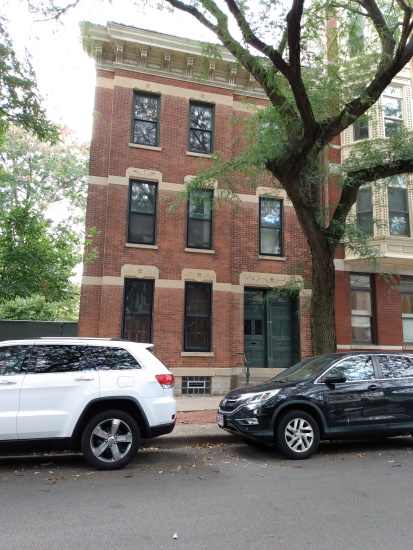
This is 1738 N. Park St. in Chicago, Illinois. My mom and dad brought me here after I was born. .
Sweet Home Chicago
After I was born, we lived in the cheap, bohemian, artsy fartsy part of Chicago. My mom called the place where we lived “Bug House Square.” She said at night, with all the lights on in the kitchen, she would plug up the cracks below the doors and spray bug killer. Then she would turn out the lights and slam the door behind her. In minutes she would hear scuffling at the bottom of the door and in the morning, upon opening the door, would find a giant pile of dead cockroaches that had tried to flee the poison.
At first mom had her teaching job and dad went to art school. In his free time, he would golf. My dad would have loved to be a professional golfer. Maybe it was my arrival that made him give up this dream. But he didn’t give up golf. Oh no, he golfed all his life, chipping practice balls in our back yard and going off to the golf course every chance he got. In Chicago it made mom sad and angry that he would go off to golf because he sometimes would go off and golf with women he met somewhere. Mom had to stay home with me. This made her resent him at the time, and this resentment continued all the time they were married. I believe that my Dad did not think anything was wrong with this behavior, but I know my mom felt betrayed because she told me this when I got older. She wanted to be the center of his world, but he couldn’t because he was essentially a self-centered person even though generous at times, and this was too bad because mom was a pretty sweet catch which he should have appreciated more. On the contrary I think he thought that he himself was the catch and that she was the one who should appreciate. This dynamic eventually led to divorce thirty years later. He wanted to be the center of the world and she wanted to be the center of his world. When two people have that kind of dynamic a good marriage isn’t going to happen. After I married and my own husband started to behave this way it caused the same kind of resentment in me and eventually, we split, too. When two people meet to give, both get 100%. When two people meet to get, no one gets anything. This seems to be the state of affairs with human beings. Hardly anyone meets to give. Most meet to get, or there’s an uneven split. 60/40. 30/70. I wish I had understood this better when I was young. My own relationships with men would have been a lot better and certainly different.
But in the beginning in Chicago and maybe even for a few years in Marshalltown they got along well enough and more often than not things were harmonious. The full blown rancor came later.
Mom
My mom was born in Illinois to German farmers and educated people who were preachers. People who could come up with a unique sermon for the congregation every week. She told me that when she was young, she was a very energetic person, that she ran everywhere. She had a strong personality even then and I’m sure she got this from her mom, my grandmother Frieda who was a house ‘a’ fire and then some. For example when my mom’s younger sister LuVerne was treated unfairly by a teacher in the one room schoolhouse where they attended school my mom stood up for her and bawled out the teacher. Imagine the chutzpah in the mid 1920s.
From left: Gram’s sister, mom with the dark brown Buster Brown haircut, blonde Uncle Kenneth, grandpa Bernhard, grandma Frieda in the kerchief, red-headed Aunt LuVerne, great grandma Tina, great grandpa William.
I only knew mom when she was an adult. Who knows their parents any other way? This is a sad state of affairs to my way of thinking and part of the reason I am writing this. This is so all the people who might have only known me as an adult might know a bit about me in other ways. Like when I was young. It’s the only control I have over time which is really no control at all.
As an adult my mom was an art teacher and book illustrator. She was a very creative and frustrating person to me. Maybe she was frustrating because she was so creative. I don’t know. I do know that she was not like everybody else I knew. Other people might have been boring, but my mom was not boring in any way. She was a combination of fear and courage for one thing. She couldn’t or wouldn’t do some things and I guess it was because she wasn’t confident but on the other hand, she was vivacious and fun, full steam ahead. Yes, she was complicated. She was not easy. Looking back, I can see that her life must have been frustrating for her, too. She could have been so much more, and yet, I can say with certainty that she did the best she could with her lot in life. When she got older and I looked at pictures of her I thought, “That person looks like they have had all the life sucked out of them. That person looks deflated.” Is this what happens to us? Why do some people still have vitality as they age? Why don’t other people? My mother lost her vitality as she aged. It was so strange because when she was young, she was a hot potato, a bottle rocket with zing! Some days I think I know what happened to her. Some days it’s just a theory. But I can relate because I was full of vitality when I was young and, now, I’m just tired out.
When I was young, I sometimes needed to ask her advice like any daughter would. Much to my chagrin she would come up with an impossible and outlandish idea to what I thought was a reasonable question. Her answer, if executed, would have been truly amazing, but was going to be absolutely impossible for a teenage kid like me or for almost anybody else for that matter. Me: “Mom, I need an idea for how to decorate the cafeteria for the prom.” Mom: “How about an ocean cruise theme where the cafeteria is decorated with portholes and set on hydraulics, so it rocks back and forth like ocean waves.” Was she not taking me seriously or just trying to drive me crazy? I’ll never know. More about my mom later. This is just an introduction.
Dad
I have been told that my dad was an art student when my mom met him in Chicago. He was on the GI bill going to the Chicago Art Institute and he had already studied at the Nottingham School of Art in England after World War II. Mom told me that she married him because she didn’t want anyone else to have him. What a funny reason to get married! And I hope and pray that she actually loved and respected him, too! But I’ll never know now. After he got his art degree, he became an art director at a big heating and air conditioning company in Marshalltown, Iowa. He had a disdain for the corporate world. In Chicago at a job where he worked he went in to ask for a raise. “We just had a baby girl so I need a raise.” The next day they let my dad go. This made him very angry and he never forgot it. This was in the day before you could do something about discrimination. In those days you just had to suck it up.
Like my mother he wasn’t ordinary either. Never boring. Ordinary people had landscape reproductions and prints of Jesus on their walls, but my mom and dad had real paintings done by them or by people they admired. My dad could sing and dance and tell jokes like there was no tomorrow. No, neither my mom nor my dad were boring. Maybe that was part of the problem. Some days I wished they were a little more boring. They kept our home in a tumult. All I wanted was a little peace.
My dad was a practical person, too. My mom’s vivaciousness, which was probably exciting to him at first, got to be tiring as the years went on. He also caused her to feel insecure and jealous. He thought she was being hysterical and unreasonable when she wanted to know where he was going or what he had been doing and with whom. He gave her grounds for wanting these questions answered. She wasn’t hallucinating or fabricating stories. This was my dad’s narcissism. I’ll talk more about his background later on but for now suffice it to say she was smart in a way that probably intimidated him. He was blue-collar and he painted what he saw in a realistic way according to the norms of the day. He approached painting like a tradesman or a carpenter. He would say, “I’m going to build a painting.” But he was adept enough that he was never pedestrian. He inserted elements of impressionism and abstraction into his paintings. But in his heart he was a tradesman. He approached life the same way. And he wasn’t as educated as she was. He would say, “Marge, you have a college education and you can’t even cook a hamburger.” What does that say to you? I think it says he felt not as good as her. After all he didn’t have a college education. It seemed that what he really wanted was someone to cook good food, keep house and have kids. He was not ambitious. He did what he had to do and didn’t aspire to anything more.
Scenes from EarlyLife
Even though there was tumult in our house there was an element of average even though it was a very small element. My mom had a domesticity that was efficient and warm. There is a picture of me in my highchair cramming tiny fistfuls of my mom’s homemade noodles into my mouth. My face is covered with noodle debris. Dad called me The Noodle Kid. When you looked at our household from a 20,000 foot level you would say we were a pretty average Midwestern family making ordinary food and doing ordinary things. My dad golfed and gardened. My mom cleaned and cooked and planted flowers.
But we were not average. Mom and Dad chose dark brown to paint our house when everybody else had some pastel shade. Mom planted corn and castor beans around our house while everybody else planted petunias. Mom played the oompah piano and dad sang along. Dad played the “Marriage of Figaro” by Mozart on the stereo system he built. Mom played Joan Baez and Simon and Garfunkel. Nobody else enjoyed the kind of music they did. We had backyard picnics and ate hamburgers, yes, and boiled corn on the cob with potato salad and cole slaw like everyone else but that was a nod to the Midwestern way of life for them. They aspired to more. Dad hunted like other dads but instead of a rifle he used a bow and arrow. Nobody else I knew did these things, so I felt different and set apart from our neighbors. It wasn’t until years later that I figured out exactly how different we were. You have to get away and see how other people live to get perspective, and I did, and this feeling has stayed with me all my life.
(This is an excerpt from my Memoir “Just Walk Away” which is a recollection of people, places and things.)
When I look back on my life it seems that I was always leaving something behind.
Chapter two: Insects
We had lots of picnics in the back yard and friends of the family came over for hamburgers and corn on the cob. So did black corn beetles. They were first in line to crawl on your food as best they could so you had to pay attention when you were eating because you might chomp down on one. There were mosquitoes that bit you and chiggers that got into the crease of your skin at the waistband of your shorts and itched something fierce. If you were running barefoot in the yard you might step on a bee and then mom would scrape the stinger out and put a bread and milk poultice on your swollen and itchy foot to, according to her, suck the poison out. When it got better, she would soothe the inevitable itch with baking soda mixed into a paste with water that would get all over the place when it dried. We never learned. We went barefoot constantly. Once I got a trip to the emergency room when, chasing lightning bugs, I tripped and fell and gashed my forearm on a broken glass bottle that was sticking out of the dirt. I was quite young, maybe five. I guess in the old days, before the subdivision was built, the Schulz’s had used the back part of our yard as a trash dump. I still have that scar on my right forearm. You could identify my dead body by it if you wanted.
Strife
My mom and dad yelled and screamed at each other in that house. You could hear them all over the neighborhood which was a source of embarrassment to me. I don’t know what they particularly argued about except I would eventually hear my mom say as my dad stomped out the back door, “Where are you going, Art?” My dad was an old-fashioned guy who thought women were there to do men’s bidding and it was none of her business where he was going. Once my dad hit our mom during an argument. I heard him slap her and I heard her crying. That was it. I’ve blocked the details out. What I do remember was that it frightened us kids very, very badly. We never knew what caused him to slap her. We knew that he had a bad temper and could get angry over the smallest things. He had zero patience. When I was quite a bit older my boss at the non-profit gave me a phrase that seemed to fit him perfectly: “Street Angel, Home Devil”. Lisa was from a Long Island, New York Italian American neighborhood, and they had many colorful phrases to describe people. Everybody outside our family loved my dad for his humor and quick wit. In our family we feared and obeyed him. Mom sometimes pushed back but was never able to prevail in getting him to be a kinder person. He was what he was, and he stayed that way. OK I admit that he could be kind. Extremely kind and thoughtful. Every year he gathered armfuls of lilacs for my mom on her May 15th birthday. Yes, he wasn’t all bad!
Mom In More Detail
As a mentioned before my mom was a very clever, smart person though insecure and frustrating. On her best days she came up with all sorts of fun things for us kids to do. On birthdays she might make it a pirate theme and have a treasure hunt complete with a map and some kind of treasure to discover. We’d dress up in pirate clothes and have a whale of a time. In the summer she dug big holes in the back yard, lined them with plastic, then filled them with water for us to splash in. On Halloween she would go all out sewing costumes. She drew us girls paper dolls with clothes to match. Then we’d cut them out of the paper and dress our paper dolls. Once an older girl named May Polley cornered me and demanded that mom make her a paper doll, too. She wanted a Cinderella doll like I had. I ran home terrified and in tears. Mom made the paper doll, which I then gave to May and she never bothered me again. Maybe it was a lesson in giving in to bullies or maybe it was a lesson in picking your battles. In the picture you can see the little tabs on the side of the “dress”. Those tabs are meant to be folded over. They aren’t some weird appendages. The tabs were integral to the dress because when they were folded over, they kept the dress on the doll. It was really good fun dressing the dolls.
My mom had time to do all this stuff because she never worked outside the house. It was a time of prosperity in America after World War II, and we could get along on my dad’s salary, but we weren’t flush with cash or rich by any means. We lived a frugal life without extreme penny pinching. Now and then I would ask mom how come we can’t have this or that, like some neighbor kids had, and mom would always say something like it’s because we spend our money on insurance and those people don’t have any. Yes, she said this and I never knew if it was true, but I accepted it as a reasonable answer. We didn’t live a life of luxury or privilege, but we had what we needed.
Food
This is a Big Section because food is important to people in the Midwest, and we were no different.
I say important because invariably upon finishing breakfast mom and dad would be discussing what they were going to have for lunch. After lunch they would then be discussing what they were going to have for dinner. It was like that.
The majority of our food was home cooked from scratch. Mom never bought sugary items at the grocery store, for example. I envied kids who had Sugar Pops or Frosted Flakes in their cupboards. If Mom did buy boxed cereal, which was rare, it would be Wheaties or Wheat Chex. Mostly we had the hated old-fashioned cardboard flavored oatmeal or Cream of Wheat. To make either of those tolerable we added a pat of butter, heaps of brown sugar and a little milk. We didn’t have desserts in our house except for the occasional grocery store brand Fastco ice cream that came in a square paper carton. It was always vanilla and it was terrible but at the time we didn’t know better and accepted it as tasty. Once in a while she would come home with Neopolitan ice cream, in the Fastco box of course, which was strawberry, chocolate and vanilla in sections. It was good enough and we ate it.
Some lucky kids had fudgsicles in their freezers and, boy, did I envy those kids! Mom considered these specialty or exotic items, and we never had any. The most daring thing mom got were the almond windmill cookies from Archway which were also known as Dutch Speckulaas. They were ginger flavored mostly and there were little bits of almonds in them. They were in the shape of, you guessed it, windmills. While we’re on the subject of cookies, once I came home from school and my mom was not home. I must have been 8 or 9. When I looked in the cupboard for a snack, I saw some boxed coconut cookies covered with chocolate and caramel. What is this? Why are these here? This is very strange and completely out of the ordinary! I was terrified to eat one, this is how rare this was. I thought, “Maybe they were put there by bad guys and they’re poisoned, and they want me to eat one, so I’ll die.” I closed the cupboard and walked away even though they looked incredibly good. Then I obsessed and obsessed about them but kept my composure. I kept going to the cupboard to check if they were still there. Eventually mom came home, and they turned out to be legit. They were Keebler Coconut Dreams cookies and a friend had given them to her.
When I got older, I was glad that we never had many sweets. I think that having very little sugar helped me have good teeth and not get overweight. As a matter of fact, unlike everyone I knew I absolutely loved going to the dentist. Dr. Warrington would come in the exam room, take one look in my mouth and exclaim, “You have such beautiful teeth!” I was a vain young child easily overcome by flattery, but it was true. My teeth were straight, and I didn’t have any cavities. I never had to endure the agony of braces like many of my friends. I even had the added advantage of having a little gap in my front teeth that I could squirt water out of to annoy my friends at the swimming pool. Later on, the gap closed and this was perfect because it helped my teeth to stay straight. Room to move, you see. Sigh. Such a perfect child!
It’s not that we didn’t have our indulgences. Near 15th Avenue there was a small grocery store with a bakery in the back. It was around the corner of Fifteenth Avenue and down the street on Nevada (Nuh-Vay-Duh not Nuh-Vah-Duh. Remember this is Iowa!) where we would buy frozen Snickers bars and Slo-Pokes in the summer. They also had the best white bread baked in their own ovens. One of my favorite snacks was two huge slices of that bread with as much Miracle Whip as possible slathered on it so it skooshed out of the sides when you pressed down. Only Miracle Whip. Nothing else. Not mayonnaise. Nothing. I would lick off the skooshed out Miracle Whip that I loved so much. I’ve found that people who are not from Iowa or the Midwest don’t understand the attraction of Miracle Whip. Everybody in the Midwest uses Miracle Whip. It is an ingredient in just about every recipe you can think of. Deviled eggs don’t taste right without it. Turkey sandwiches after Thanksgiving don’t taste right without it. Potato salad doesn’t taste right without it. Coleslaw doesn’t taste right without it. Waldorf salad doesn’t taste right without it. Macaroni salad doesn’t taste right without it. I like mayonnaise now but when I was young it had to be Miracle Whip.
We also fried bologna to put in a sandwich and ate hot dogs raw and uncooked. My brother lived on Franco American spaghetti out of a can or Campbell’s tomato soup with half a package of saltines crushed in it. On Sunday mornings we had pancake eating contests while my dad flipped pancakes as fast as we could eat them. “Who wants another pancake?” he would yell out. “Me!” we would yell back. These were silver dollar sized pancakes mind you. Not the ginormous restaurant size. You could eat a lot of silver dollar sized pancakes.
On Sunday night mom made Swiss Steak cooked in the pressure cooker and served with mashed potatoes. She’d get a cheap cut of steak and pound the heck out of it with a meat mallet, so a lot of flour was mashed into it. Then she would chop carrots and onions and pour a can of chopped tomatoes in on top of the meat in the pressure cooker. Then we watch in fascination and fear as the little bobble thing on top of the pressure cooker would let off steam. Would it explode, or wouldn’t it? We never knew but it never did.
When it was all done, we would pile a mountain of mashed potatoes on our plates and then put a big piece of tenderized meat on top with the gravy over. You could eat the meat with a fork it was so tender. My lifelong enjoyment of liver and onions also began here. I don’t know how my mom made it, but it was never dry and chalky. Of course, we drowned it in ketchup. And, oh, the onions! You had to have a mound of pan-fried onions, slightly caramelized on the whole she-bang. Sometimes she made what she called Neopolitan spaghetti which other people call American Goulash. This was cooked macaroni noodles in a sauce of hamburger and canned tomatoes all mixed up. This, too, was high eatin’!
When we went out to eat, which was not often, we had some choices and one of the choices was a café near the Third Avenue bridge that had a bar in the front and a restaurant in the back. It was kind of seedy but we didn’t care. Their signature dish was a dinner plate size pork fritter with French fries. The bun was this ridiculous looking tiny thing in the middle of the giant pork fritter which had a couple of dill pickle slices and a dollop of yellow mustard. The fritter itself was pounded wafer thin, breaded and deep fried. You would eat your way to the bun and, boy, did we love it!
The other treat was the Maid Rite sandwich. When I was older Hilary Clinton came to Marshalltown on a campaign tour and the first thing out of her mouth was the announcement that she had been to Taylor’s Maid Rite, and she could tell us with certainty that “They are Made Right!” Of course. Tell us something we don’t know. The Maid Rite was a white hamburger bun piled high with ground sirloin cooked until it fell apart. My sister Toni once made a very good imitation of Taylor’s secret recipe. Roseanne Barr, the comedian, called it “loose meats” and had a café in her TV series that sold them. Loose meat is a terrible name for this delicious sandwich. That makes it sound perfectly revolting. It was perfection on a bun with pickle and chopped onion and yellow mustard. NO ketchup. Ketchup had been pulled from the menu in the Great Depression because bums would come in, sit themselves down at the counter, order a cup of hot water then proceed to add a bunch of ketchup for a strange kind of soup.
To go with your Maid Rite, you had to have one of their amazing, malted milk shakes. A spoon would stand straight up if you stuck one in. It was kind of a magic taste, the Maid Rite along with a slurp of malted milk. They did not serve French fries. It was perfect just those two things. In this picture there’s ketchup so this was not a picture taken in Marshallburg unless they gave in for the Clinton. I also see French fries. We did not have these when we were kids. Verboten.
Photo by David Howells/Shutterstock. I do not think that this is Taylor’s in Marshalltown because I see ketchup and french fries. Has Taylor’s succumbed? I don’t know because it’s been years since I’ve been there.
Sometimes on a hot and humid night in summer dad would say let’s go get ice cream and then we’d pile in the car to drive to a creamery in Tama (Tay-ma). We’d be driving in the dusk along highway 30 and I’d look out the window at the miles of corn fields with billions of lightning bugs flashing and wonder how there could be so much corn. I didn’t eat that much corn. Why was there so much corn? Sometimes we’d go to the Tastee Freeze south of town on highway 14 and get soft serve that was dipped upside down into chocolate and the chocolate would then harden. You’d eat a hole in the chocolate and then suck the soft serve out while your tongue was trying to keep up with all the ice cream drips down the side of the cone. John Cougar Mellancamp immortalized the Tastee Freeze in one of this songs.
On the north side of town on highway 14 was the A&W root beer stand. The car hops would come out to your car and take your order and then come back with your food and drink on a tray that attached to the side of the car. That root beer came straight from heaven. The mug had been in the freezer and the sides of the mug were frosted over. Maybe there would be a hot dog along with it, but you didn’t really need it. The root beer was outstanding all by itself. Now any other kind of root beer is pale by comparison. I even tried to make root beer once, but it didn’t taste anything like A&W. I’m spoiled for the taste of true old fashioned root beer now because Mr. Allen and Mr. Wright got the right ingredients and threw away the key in 1919.
Another summer excursion would be a trip to the outdoor drive-in to watch some cowboy movie and have terrible salty popcorn from the concession stand which, of course, I loved. We’d park next to the speaker attached by a long wire cord to a pole. Mom would take it off the holder and hook it over the door. The sound was awful but that didn’t matter. It was all part of the drive-in experience. We’d watch until we fell asleep in the back of the car and then somehow get home arrive home and wake up in our own beds the next morning.
There was only one pizza place in town at the time. Luckily it was and still is the best pizza on the planet. It rivals any pizza you can think of. Chicago pizza, New York pizza, wood fired pizza. None of them hold a candle to Zeno’s pizza. I think they used provolone instead of mozzarella and it was the cheesiest greasiest saltiest pizza on a thin crust pizza you ever had. The atmosphere was great. Everybody had their little booth, and the decor was kitchy Italian with fake grapes and flowers garlanded on the walls.
At Shady Oaks restaurant east of town on Old Highway 30 (also known as The Lincoln Highway by the way), I would always have a giant wedge of iceberg lettuce with Roquefort cheese dressing poured all over. I thought it was quite special and unique that they brought to the table those triple dispensers of salad dressing with a choice of thousand island, blue cheese and Italian dressing so you could ladle out the dressing out to your heart’s content. It wasn’t sanitary but we didn’t think anything of it. At home we didn’t have salads. We had vegetables.
Then there was Milt’s on S. 12th Avenue. This was a hamburger joint, but the attraction was Milt himself. We kids watched in amazement as he poured our milk into our glass going higher and higher until he was pouring it from 3 feet above the glass. When Milt retired it became a Chinese restaurant and dad would say, “Let’s go get flied lice.” He thought this was funny and didn’t realize how derogatory it was to say it that way. The food was actually pretty good. Your standard Americanized Chinese food. They had Egg Fu Yung which was smothered in some kind of beefy gravy and pork fried rice as well as Chow Mein. Not your gourmet fare but we had never had anything gourmet so we had nothing to compare it to.
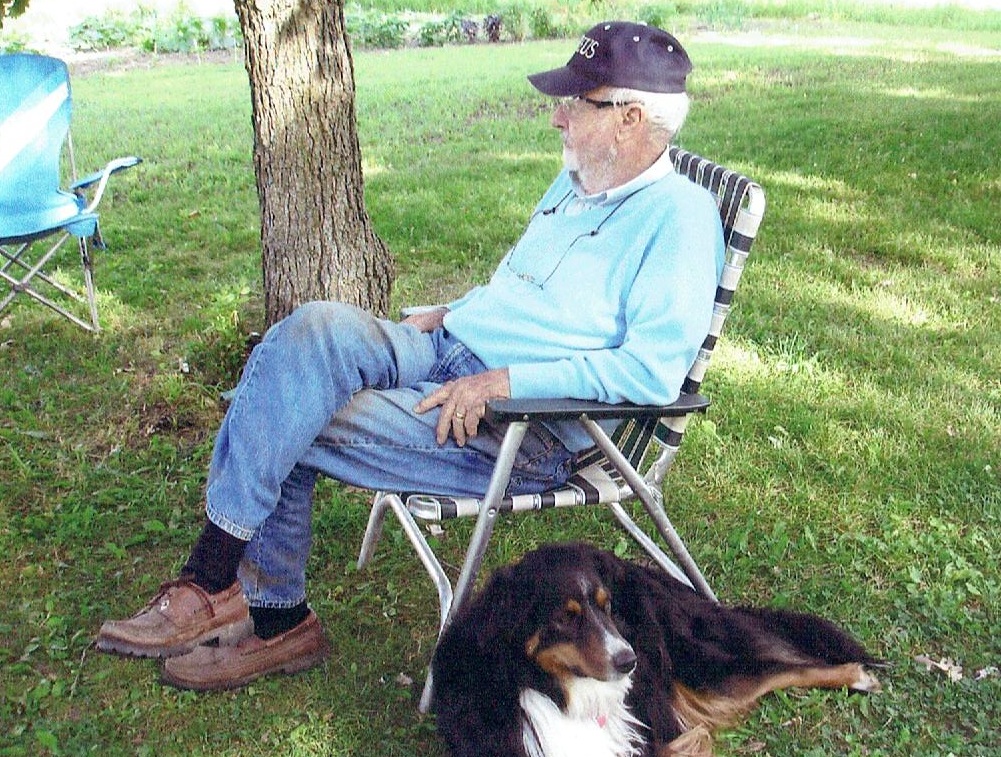
My dad and his dog. He never told me anything about what it was really like. I didn’t think to ask.
Myth: Old people are stick-in-the-muds and don’t go anywhere because they are crotchety homebodies.
Truth: Old people would love to go everywhere all the time, but old people are probably living on a fixed income and don’t go anywhere because they can’t afford to.
Myth: Old people are hypochondriacs and go to the doctor for every little thing because they love the attention.
Truth: Old people go to the doctor a lot because there’s always something going wrong. Everything hurts on an old person and is giving out. Old people were the picture of health when they were young, and they never saw this coming.
Myth: Old people are lazy and don’t like to exercise.
Truth: Old people would love to exercise if exercise didn’t hurt for days afterwards. Aches and pains that might have taken a couple days to dissipate when they were young now take days and days to get back to “normal”. Whatever “normal” is. Normal is different now.
Myth: Old people are more cautious than young people because they’ve lost their joie de vivre and are now conservative party poopers.
Truth: Old people may have lost their joie de vivre but it isn’t because of what you might think. Old people are more cautious than young people because they’ve realized that it isn’t worth the risk whatever “it” may be. Remember the song by Peggy Lee, “Is that all there is”? Old people have realized this was a true song. It’s going to be a disappointment.
Myth: The Golden Years are a wonderful time of life
Truth: The Golden Years is an idea made up by a young person. There’s nothing golden about it. If anything, it’s the Gray Years. “No matter how bad things get, remember these sage words: You’re old, you sag, get over it.” — Sophia from The Golden Girls TV show
Myth: Sex is better when you’re old.
Truth: This is also something made up by a young person, probably a young doctor or a young journalist. The truth is in old age something is always not working so unless you’re into drugs and surgical procedures you need to come up with other ways of intimate pleasure.
Myth:There’s no or very little age discrimination in hiring practices concerning old people.
Truth: Age discrimination is alive and well in hiring practices of old people. Old people can apply all they want to American jobs but the certainty of getting them is all but certain even if the old person is eminently qualified. Usually they say, “We found a more qualified person.” This is code for “You’re too old.”
Myth:People have respect for the wisdom that is acquired by age.
Truth: Nobody cares what old people know or what their wisdom can provide. Young people think they know it all and the last thing they want is for some old person to tell them anything. Old people know this is true because when they were young, they didn’t want some old person telling them anything even if it made sense. Especially if it made sense.
Miscellaneous Truths: Getting up to pee many times in the night is common. Leg pains from taking medicine is common. No amount of Botox can get rid of all the wrinkles. Eating anything and everything in any amount is a thing of the past because now there’s acid reflux. Fallen arches are common but there’s the Good Feet Store if you can afford it. Forgetfulness is common and they’d like you to think this means you’re on the verge of getting Alzheimer’s.
Youth was a time of gaining things. Old age is a time of letting things go.
The boys had been hang gliding that day. This was years ago but it seems like only yesterday. I was their chase driver and I liked it. I liked being behind the wheel of the SUV alone with my thoughts and looking out at the landscape as it went by. There was that feeling of freedom somewhat anchored by a purpose. This is my ideal life. I like freedom coupled with a sense of purpose. When purpose becomes uncoupled, I’m like a boat on the water with nothing but freedom, no anchor and drifting.
Everyone had a good day. The boys had flown far and landed unscathed. I had been able to pick up the two I was assigned to without difficulty or getting lost. We were back at the camp site that was called Tuttle Creek which I said was famous for all the tuttles. You know, box tuttles, painted tuttles, desert tuttles. Tuttle Creek was right there adjacent to the famous Alabama Hills. In the old westerns the Alabama Hills were the on-location scene with Whitney Portal as the backdrop and I can see why. They were a very interesting rock formation.
It was the fourth of July and we wanted to see some fireworks. So, after dinner we piled in the SUV to see if Independence was doing anything. They were. We joined the citizens of Independence on the shoulder of Highway 395 and waited. Highway 395 follows the eastern flank of the Sierra Nevada and you can get a good look at Whitney Portal as you drive 395 through Lone Pine. Independence is a little farther south on 395 and usually has a fair amount of traffic but tonight there was none or very little and we waited in the gathering dusk for the show to begin.
And soon it did. A flat bed wagon pulled in and was set up with chairs for the dignitaries of Independence and the master of ceremonies. The flat bed was off to one side of a large empty sagebrush field north of town. Some one over there was in charge of the fireworks but we couldn’t see who. Eventually we heard the PA system crackle to life. It was dark now, around 9 pm.
“Welcome to the 30th annual Independence California Fourth of July Celebration!”, he said. “Let’s begin by singing our National Anthem.” We all rose to our feet as the PA played a rousing band version and we sang. When we finished singing…
The announcer announced: “For our first display we have something from Ace Hardware on Main street.”
A minute goes by…
Ka-boom!
We all ooo-ed and ahh-ed.
Each fireworks was announced in succession. Apparently, the city had no budget of their own. Every fireworks was paid for by a local business.
“This display comes to you from the law offices of Harvey Smith.”
A minute goes by…
Ka-boom!
“Our next display is courtesy of Eastern Sierra Ice Cream Company.”
A minute goes by…
Ka-boom!
But now we have a sage brush fire that is started by embers falling into the field! Ah-rooooooooo! Here comes the Independence Fire and Water truck roaring down the highway. It two wheels it into the field, slams on the brakes, the driver jumps out, grabs the hose and begins to pour water on the fire.
We get a bird’s eye view of this from our SUV, and it is all quite entertaining.
Fire out. We go back to the MC.
“Our next display comes to you courtesy of Inyo County Water Department.”
A minute goes by…
Kaboom!
We only had 3 more fires (what a successful night!) and three more fire truck sorties to the rescue. Such is life in a small town on the eastern slopes of the Sierra Nevada.
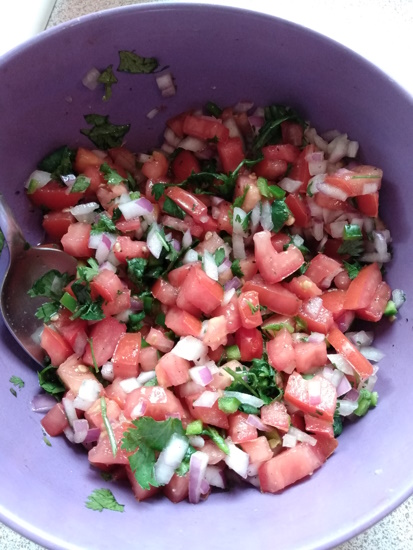
Pico De Gallo is a Mexican salsa that’s loaded with all the things that are growing well in my garden. Pico de Gallo, by the way, (translates to “beak of the rooster”. Don’t ask me why they call it that. They also call a food item wrapped with a tortilla “burritos” (little burros), and deep-fried pastries “churros” (sheep). It’s a colorful language and culture.
The things that don’t grow well in my garden aren’t ingredients in Pico de Gallo. (eggplant, green beans, okra, potatoes). Last year I grew a lot of native crops, but I wound up not using them so I’m not growing them this year even though they grew very well. (black eyed beans, buckwheat, sorghum, amaranth). Now I’m branching out to things that I like to eat. And I’m having trouble with the birds. They eat everything that isn’t a Pico de Gallo ingredient. And guess what? The birds are winning! Things that the birds don’t seem to like are the things that go into Pico de Gallo. (tomatoes, onions, jalapenos, cilantro). They are growing well and I’m sure it’s a southwestern thing. If I had a lime tree, I would have all the ingredients. Pico De Gallo is excellent over tacos, burritos, nachos, or served with chips. You can make up a batch in about 5 minutes.
Pico de Gallo salsa
Ingredients
1 lb Roma tomatoes, (3-4 medium), diced
1/2 medium onion, (1 cup chopped)
1 jalapeno pepper, seeded and finely minced
1/2 cup cilantro, chopped
2 Tbsp lime juice, from 1 lime
1/2 tsp salt, or to taste
1/8 tsp black pepper
Instructions
In a medium bowl, add diced tomatoes, onion, jalapeno pepper and chopped cilantro. Stir in 2 Tbsp lime juice and lightly season with salt and pepper, or season to taste. Enjoy right away or cover and refrigerate overnight.
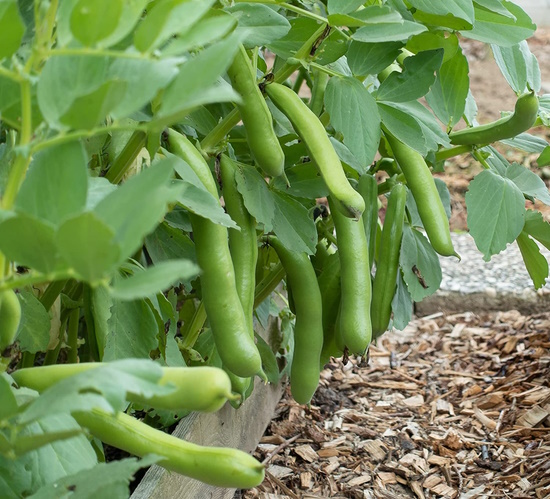
I grew my own fava beans this past winter because I’d never eaten a fava bean and I was mighty curious. I planted the fava beans in the fall expecting them to bloom and get seed pods before winter fully set in. In the beginning they grew well, and they flowered. They have quite a pretty flower resembling a sweet pea. Then winter set it and it set in with a vengeance. Well, a vengeance by Arizona standards. Here’s how winter sets in with a vengeance in Arizona: it went below 32 degrees for days on end. So, I put up a makeshift greenhouse to protect my favas from the cold and it worked. But then it didn’t work. It got too cold for too long. Eventually the tops of the plants went black and withered so I chopped off the black parts and waited to see what would happen. There were still some of the green plants left low to the ground. I did not have much hope.
And then…
It started to warm up and the plants started coming back! They re-bloomed and seeds pods started to grow and last week I harvested. A miracle! My tough little favas. I love them so.
So, I looked around for a recipe that intrigued me, and I found one on Jamie Oliver that is the bomb! I modified it some because I didn’t have all his ingredients. I didn’t have the feta cheese he suggested so I used parmesan. I also didn’t have sourdough, so I used a baguette. I didn’t have fresh rosemary, so I used dried. I was too lazy to make his dressing, so I just added tomatoes to a balsamic vinaigrette I already had.
Here’s my version.
Try it. You’ll like it. You can leave off the chianti and liver.
Fava Bean and Peas on Toast
About ½ cup good homemade balsamic vinaigrette dressing
2 spring onions
4 ripe cherry tomatoes
EVOO
Bunch of fresh mint
1-2 cups broad beans (frozen or fresh) (if you haven’t grown your own most Mexican markets have fresh)
¼ to ½ cup peas (frozen or fresh)
2-4 slices of bread (sourdough or baguette sliced in half lengthwise as to be toastable)
Clove of garlic
Rosemary (1 sprig of fresh or a ½ teaspoon of dried)
Parmesan or Feta cheese
Chop the cherry tomatoes into your balsamic dressing. Let set at room temp to marinate. You can add a bit of fresh lemon juice for piquancy.
Pick the mint leaves off the mint stalks, set aside, and tie the stalks with a string. If you’re lazy like me just add the mint stalks to a pan of boiling water and blanch the prepared fava beans for a minute.
Fava Bean preparation
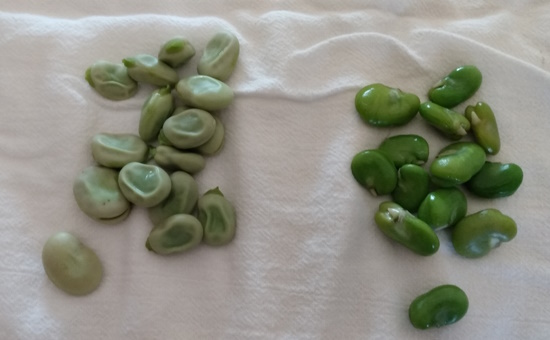
OK, I admit it. Fava beans aren’t the easiest in the world to prepare but they’re not the hardest either and they’re so worth it, I think. If using fresh pick some plump pods, trim them and remove the green outer husk to get to the big seeds inside. I discovered how to get the outer husk off the big seeds by accident. I was going to just blanche the big seeds and freeze them for later and then I looked and saw that the big seeds were wrinkling. Whoops! The outer husk almost slides right off and there inside are the most delectable little green interiors. Once you have about a couple cups, put your bean interiors in a pan of water and boil for a minute to blanch.
Fava beans blanched and unpeeled on left. Fava beans blanched and peeled on right.
After the minute, using a slotted spoon, scoop out the blanched beans and put ¼ to ½ cup of frozen peas in the mint water and blanch them, too. Add the blanched beans to the dressing and then drain the peas and add them to the dressing, as well. Finely slice the mint leaves and add to the dressing/bean/pea/tomato mixture. Toss well to combine. Toast the bread and take a garlic clove, cut it in half and rub it all over the toasted bread. Sprinkle with a little sea salt and a little good olive oil. Pile the beans on and shave parmesan or sprinkle feta over.
For a little extra oomph, you can sprinkle extra chopped mint, a drizzle of lemon juice and chopped green part of green onion.
(I’m making a departure from Joy of Cooking because Marlene requested this recipe. Have fun, Marlene, and everybody else!)
I love 2 kinds of donuts: buttermilk bars and old fashioned. None other really. And even these two I don’t like with a ton of extra sugar all over them. I definitely don’t like them with any doo-dads like sprinkles. Marty is the opposite. The more sprinkles and doo-dads the better. To each his own I say. He’s also okay with store bought donuts. I used to be but somewhere along the line they started using a mix that makes all donuts taste the same. Store bought donuts also have a weird mouth feel, an icky waxy coating at the roof of my mouth.
So, when I saw this recipe, I thought OMG I’m going to make them, and I hope they turn out really well. They did! I learned a thing or two and I’m passing my learning on to you. Maybe you will make them and enjoy them as much as I did.
Tips
Use whatever sugar you have on hand. I used equal parts granulated and brown sugar, but you can also use all of either one and they’ll be good too. But no guarantees. I can guarantee my recipe LOL.
Be generous with flour. This dough will be very sticky, almost like a very thick batter. More on that later. Don’t be afraid to flour your hands and equipment generously to prevent sticking.
If you have a fish spatula or a spider to transfer the dough to the oil. I used a slotted spoon.
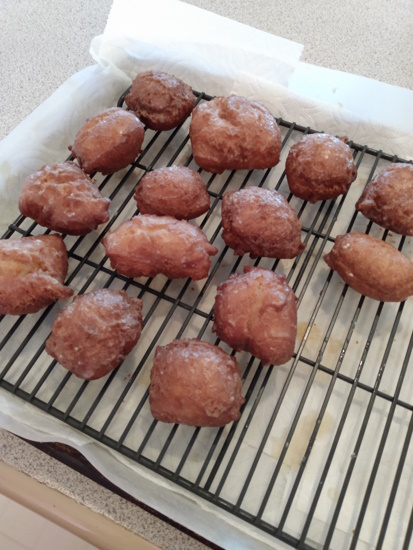
Don’t worry about how they look. They’re meant to be tasty. Not perfectly shaped.
Buttermilk Bar Donuts
If you make the whole batch, you will get somewhere around 30 bars.
Donut Ingredients
4 T (1/4 C) unsalted butter
3-1/2 C cake flour (use cake flour. It has less gluten in it for a lighter finished product) + more for dusting.
2-3/4 t baking powder
¼ t baking soda
1-1/2 t kosher salt (kosher is just salt. No anti-caking ingredients or even dextrose/sugar)
¾ t ground nutmeg
½ C packed light brown sugar
½ C granulated sugar
1 large egg
3 large egg yolks
¾ C buttermilk
About 2 quarts vegetable oil (I used canola) for deep frying
Vanilla Glaze Ingredients
2 C powdered sugar, sifted if lumpy.
1 T vanilla extract
¼ C boiling water
Bars
Place unsalted butter in a small microwave safe bowl. Microwave on high until melted. Set aside.
Place the cake flour, baking soda, baking powder, salt and nutmeg in medium bowl and whisk to combine.
Place the melted butter, brown sugar, granulated sugar and vanilla in the bowl of a stand mixer fitted with a paddle attachment. I didn’t have a paddle, so I used the wire whip attachment. I had to scrape the sides of the bowl frequently. Or you can use a hand mixer or electric mixer. Beat on medium until fluffy, about 2 minutes.
Reduce speed to low and add whole egg and the yolks one at a time. Scrape bowl as needed. Add buttermilk and mix until combined.
Add dry ingredients all at once and mix by hand until combined. The dough will be quite sticky. Mine was the consistency of very thick batter. If yours is this way I would suggest adding a bit more flour to make it a sticky dough instead of a very thick batter. I found later on that the very thick batter made it hard to scoop into the oil. Use your common sense. It should not be dry whatsoever. Refrigerate at least one hour or overnight. It will still be sticky but will firm up considerably.
Line 2 baking sheets with parchment. Heavily flour a work surface and your hands with cake flour. Transfer half the dough to your work surface. Sprinkle with more flour. Pat into a 3 x 24-inch rectangle about ½ inch thick. Add more flour if you need to. You will brush off the extra flour later.
Using a floured bench scraper or big knife, cut the rectangle into 1-1/2-inch-wide bars. I wound up cutting mine in half again and I’m glad I did because my dough turned out to be hard to scoop up. The smaller size made it easier. Again, common sense. Press down in middle of each bar with knife or scraper. Not cut. Just press. This gives it the distinctive buttermilk bar look. This didn’t really work well for me. Maybe it will work better for you. I didn’t care. They still tasted great.
Using a brush lightly brush off excess flour. Using the scraper transfer each bar to the baking sheet, flipping it over so indentation is down. Brush off excess flour on that side. Refrigerate again.
Fill large Dutch oven or heavy bottom pot with oil. At least 2 inches of oil. Heat to medium high heat until 350 degrees or a bit above because the temp will drop when you fry the bars. I have a digital thermometer. I don’t have a fry daddy or anything like that. Getting the oil the right temperature is essential.
Fry in batches of 4-5. Don’t crowd the pot. Use slotted spoon, fish ladle or spider to carefully transfer the bars in. Fry about 1 minute per side until they are golden brown. Transfer to wire rack. Let cool to room temperature before glazing. If the oil is the right temperature you will be surprised how little oil is used.
Glaze
Put powdered sugar in bowl with the vanilla and boiling water. Whisk until shiny smooth and lump free. Dip a donut into the glaze halfway. Return to rack.











 R L Benoit - Writer/Artist