Excerpt from Just Walk Away – A Memoir of Growing up in Iowa
We spent all our time outdoors unless it was really bad weather. This is not what many children experience nowadays. The only time we were indoors was when it was crazy hot and humid, a howling blizzard or a thunderstorm with tornados. In other words, to keep us indoors it had to be extreme weather conditions. Nowadays it seems that the least little inconvenience keeps us indoors. This is wrong in my opinion but what do I know?
Summer
If we were having extremely hot and humid weather, my refuge was our finished basement where there was a wall of shelves Artie had made for Mom and she stacked the shelves with hundreds of Life magazines that she had saved beginning of time. We didn’t have central air conditioning, so the finished basement was the best place in the house. Central AC would come later. It was cool in the basement in the summer as it usually is underground, and I went cover to cover in every single one of those magazines. I had my favorite issues, and I had ones I tried to avoid. There was one magazine that had primitive drawings of Indians torturing poor pioneer children. I can still see it in my mind, so you know it made an impression on me. I knew exactly what pages the images were on and when I came to them, I would skip over these pages because they were just too gory.
All in all, though, I really enjoyed those magazines and learned a lot from them. I learned a lot about movie stars and celebrities and to this day I know all the old-time stars by name and can identify them. Big whoop you might say but I’m not worried. They say we only use about 15% of our maximum brain power so I figure I have plenty of room for more useless information. Maybe someday I’ll go on Jeopardy and win the whole thing. Then all that useless information won’t be for nothing. Later on, when I became a graphic designer, that innovative Life magazine picture-centered layout inspired me and informed my design sense. This was also a foundation for understanding composition in painting and drawing. I absorbed it visually because like the commercial character said, “I am a visualiste. I see things visually.” (you must say that with a French accent by the way.)

In summer we went to the outdoor municipal pool at Riverview Park, and it was there that I learned to swim but not to jump off the dive board. Oh No. I did that once and only once because when I got brave enough to try it, on the way down for the brief second it took, my stomach leaped into my throat. It wasn’t such a high diving board, maybe 10 feet or so, but it seemed high to me (remember I was little) and that scared me to death, so I never did it again. We would play in the big pool and then we would laze around on our towels and eat salty popcorn or fudgsicles from the snack bar. Getting dressed in the roofless ladies’ side was weird because I wasn’t used to seeing naked older ladies and I would try not to stare but I couldn’t help myself. The peculiarities of their bodies left me revolted and fascinated at the same time. I had never seen any naked people before, not even my mother and certainly not my dad. I was shy so I always tried to change into my suit somewhere that was private, but it wasn’t always possible.
Back home in the backyard we played Annie Over which was a game of throwing a ball over the roof of our garage to our friends on the other side. We’d yell Annie Over! and throw the ball as hard as we could. One of two things would then happen, and you never knew what it would be and that is what made the game fun. First, the friend on the other side would not know where the ball was coming from. They had to keep their eyeballs peeled for it to come from anywhere. They would either get lucky and it would, by some miracle, come straight to them and they could catch it, or it wouldn’t, and then they would have to run to get it wherever it came down. If they caught it before it hit the ground, they were allowed to run around the end of the garage and try to tag/hit us with the ball. This was a game of honesty. Fair and square. We didn’t ever consider faking it or at least I never did. So, when we threw the ball, we had to then be ready to see if our friend would come tearing around the side of the garage and get us. If they didn’t catch it, then they were to yell Annie Over! and throw the ball back to us. There would be a pause where uncertainty prevailed, and nothing was happening. It was a nerve-wracking game but fun.
We also played jacks and pick-up sticks. I was very good at both because of my steady hands, and ability to keep my eye on the ball, with quick reflexes. Hopscotch was improved after we figured out that we could use little ball chains that were better at landing and staying on the square than the average rock which invariably skittered off. I learned to “keep my eye on the ball” from Artie when he’d pitch baseballs to us. “Keep your eye on the ball,” he’d say, and then underhand pitch, and as often as not I could connect with that ball and hit it over the fence.
Every little girl knew how to play jacks…

… and pick up sticks…

… and hopscotch

We skated up and down the newly paved roads of our modest subdivision in skates that attached to your shoes with clamps. A little key tightened the clamps on the skates to your shoes. It was a good thing that our roads were pretty new with very few bumps and ruttles. Even so someone would always come home with a bad case of banged up knees or elbows. Skinned knees were common, and we didn’t have elbow pads, knee pads, hand pads, helmets or nothing. How did we survive?

I learned bike riding from Artie who ran with me holding on to the back of the seat while I pedaled as if my little life depended on it. All of a sudden, Artie yelled, “You’re on your own!” and I’d be flying! My first bike was a fat tire Schwinn girl’s bike and boy did we wear out that bike. We pinned playing cards with clothespins to the bike struts so when it was going it would make a racket when the cards clipped the spokes. Our half-assed hot rods.

Summertime also meant Girl Scout camp. We were sent to camp out west of town at what was known as Juliette Low Girl Scout Camp. I’m not sure but I don’t think I ever progressed past the Brownie stage, but I still got to go to the camp. We hiked through the woods, and the counselors showed us May apples which they said were edible. We went to the activity hut and made little baskets out of reeds. The reed set had a wood base with holes in it and we threaded spokes into the hole, bent them over so they would stay put and then we wove the weft pieces in and out and through around and around until we had a satisfactory basket. We folded the upright spokes over in the same way we folded the bottom pieces and then the whole thing was anchored and there you have it. The counselors also showed us how to braid plastic strips into lanyards for badge necklaces or key chains. We ate our meals in a big dining hall which of course there it was a ruckus and loud with the conversations of girls in second and third grade, ages 7-8 or 6-8, and the older Girl Scouts who might be as old as the twelfth grade.

When it was time to sleep, we were assigned to tents, and these were the big canvas army tents that were on raised platforms but open at the bottom. There were 4 campers to a tent. In the dark we would shine our flashlights on the walls of the tents and if we saw a spider or centipede, we would then spray it with bug spray until it fell off dead. Of course, we didn’t get all of them so when we fell asleep invariably someone woke up screaming because something had crawled across her face. The tent was stained with hundreds of bug spray spots. It was a grand time.
Summer Saturday mornings were strictly for cartoons on the telly. We kids got up the very minute the cartoons started at about 7 or 7:30 am. Mom and Artie were still asleep. Then we’d marathon watch Heckle and Jeckle, Mighty Mouse, Tom and Jerry, Bugs Bunny, and Rocky and Bullwinkle. Then there was Sky King, Roy Rogers, Fury the Wonder Horse as well as My Friend Flicka. We didn’t have a color TV until I was a lot older. I watched the Beatles on The Ed Sullivan Show when I was 13 on a black and white TV. Color came when I was in high school.
I got a small record player that played 33/45/78 rpm records. We were big into musicals for some reason. I had a My Fair Lady album with all the show tunes, and I sang along and danced around. Somehow, I learned the words to Wouldn’t It Be Loverly? My friend Maggie had a Gypsy album, so we went up in her finished attic bedroom and sang along to Let Me Entertain You. We loved Natalie Wood, and we were innocent. We didn’t even consider that the musical was about a stripper, (bump it with a trumpet!) and I guess our parents didn’t know or thought it was harmless fun. None of us grew up to be exotic dancers so the exposure didn’t lead us to perdition. We just liked the music and the spectacle of it. I loved Johnny Horton singing North to Alaska and Gene Pitney singing The Man Who Shot Liberty Valance. OK, so I was cornball.
Speaking of cornball, I would go over to Jamie’s house to her finished basement where she tried in vain to teach me to dance while her record played the latest tunes. She did her best to get me to do the Mashed Potato and the Locomotion, which was a line dance. “Everybody’s doing a brand-new dance, now, c’mon baby, do the locomotion!” Talk about two left feet. I really wanted to dance well but I was like a colt all arms and legs tangled up. I didn’t really learn to dance until years later when I was in college. I finally stopped being self-conscious and I credit the hippie time for getting me over it. Then when the disco era dawned, I was adept enough to get into Saturday Night Fever type disco dancing and took lessons with my husband Paul. I got really good and could do merengue, tango, fox trot and cha cha.
Every summer we would have terrible thunderstorms where wind, thunder and lightning were just insane. And I mean insane! If a storm happened at night, we’d watch the light show from the safety of our house always on the ready to dash to the basement. The lightning fascinated me, but the thunder was loud and scared me. There would be the flash of lightning, and because the bolt was so close simultaneously there would be the tremendous clap of thunder and the house and windows literally shook. Our Weimaraner dog whimpered while she hid under our beds, and I didn’t blame her one bit. I wanted to crawl under there with her. Sometimes there would be a tornado alert and mom would herd us into the basement. She was of the opinion that if we sheltered in the southwest corner of the basement that the house, if hit, would fall away from us. She also was confident that Marshalltown would never get a direct hit from a tornado because the Indian lore she read said that encampments built where two rivers converged were safe. We had Linn Creek (pronounced “crick”) that ran through town and flowed into the Iowa River on the town’s northeastern part. We went to the basement anyway. She wasn’t that confident apparently.
She also said that we were to open windows on the side of the house facing away from the direction where the storm was coming from because she claimed that would equalize the pressure inside the house and the house wouldn’t explode. She also said look at the TV while it’s turned off and if it glows greenish then a tornado is approaching. It turned out that all the things she thought were completely wrong but at the time I believed her and somehow, we managed to stay safe because, in truth, no tornado ever happened. The truth is don’t open the windows at all because the wind will slam through your house and rip it apart. Tornados also don’t always come from the southwest. That is bogus. I don’t know about the TV set glowing. Maybe that’s true somehow with the old cathode ray tube TVs.
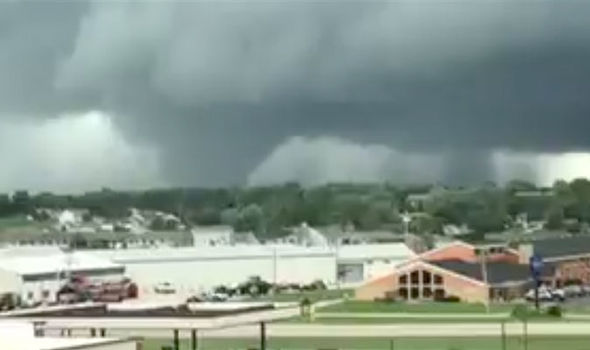
Years later, though, a tornado tore right through the middle of Marshalltown, straight down Main Street, so the truth came out. Marshalltown was indeed vulnerable all along so being where two rivers converged didn’t save our town.

The green indicates a lot of hail in the cloud.
Growing up in Iowa gave me great respect, interest and understanding of weather. On sultry summer days you could expect that by late afternoon there would be some kind of thunderstorm. Large or small, you never knew. If it was a big storm there would come the great wall cloud from the west. You could see it coming for miles because Iowa was flat as a pancake in that area. The main event of the storm, the thunderhead, was many miles high, maybe even 7 miles high which is how high commercial jets fly.
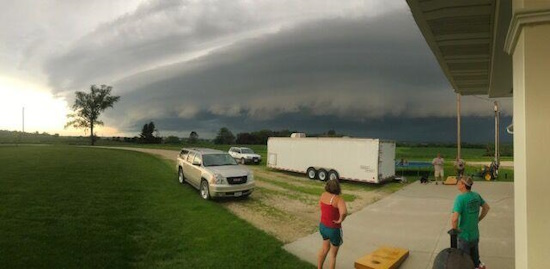
The wall cloud in front and below the advancing storm would be a creepy shade of green. All was ominously still and silent before the storm, and then the gust front hit! All hell would break loose! The rain came down in great sheets and giant drops. The wind could blow the small trees almost to the ground and branches were blown off the big trees.
Once I was looking up into the storm clouds from my bedroom window and I saw several tiny little tornados way up high. In Illinois while visiting my grandmother there was the unmistakable funnel cloud miles away silhouetted black against the western sky at the edge of the storm. Since then, I’ve always loved weather and clouds and am bored if it’s the same all the time.
Spring
Spring was great. Mom would finally be able to open the windows after the freezing winter, and it was bliss with the breeze blowing the curtains. Mom would then take the laundry out to the clothesline and after they’d been flopping in the wind the clothes and bed sheets would come in and smell fresh as the air that dried them. Nature’s dryer. It’s the best.
Unfortunately, there might be a lot of rain in the spring, and the Iowa River would flood. Riverside Park was flooded a lot and up into the streets of town close to the river. Of course, the fields north of town became giant shallow lakes and I guess that’s what made the fields so fertile with all the soil being deposited there. Then the county figured out that they needed to build levees, which they did so then the only parts of town that flooded were the fields north and east of town. In the western part of town, the homes were built on small bluffs, so they were safe.

Sometimes after a particularly ferocious cloud burst, the storm drain at the curb in front of our house would clog with debris and back up into a little lake all over the road. Mom would let us go out and ride our bikes through it or just splash around. It was paved so there wasn’t any worry about stubbing your toe on something. You heard thunder off in the distance from the receding dark cloud that was still dumping a quarter mile away and the air would be humid and cool. This was great fun.
After a hard rain, I would go with Artie to look for arrowheads in the plowed fields. It had to be after a hard rain so the arrowheads would be washed clean and stand out from the dirt. Artie would say, “Look for something that doesn’t fit.” When he found something, he’d show it to me and say, “It fascinates me that the last person to hold this (arrowhead, hide scraper, etc.) was the person who made it.” He, of course, was referring to an Indigenous person. Because the fields were wet and muddy, our boots would get covered in heavy mud, but we didn’t mind, and we thought it was a kind of laughable Mud Foot! Artie said, “Don’t step on the new corn coming up. The farmers will not appreciate it.”
Sometimes a hawk would circle overhead, and I figured out how to whistle like they do and if the hawk whistled back, I was 100% convinced that we were communicating. The sky would be blue and clear and small cumulous clouds scudded overhead in the breeze coming in from the north over the Great Plains. I was in my element.
Fall
My favorite time of year was fall. By fall the Iowa River would be very shallow, and we would drive north out of town to Timmons Grove County Park, walk down to the water and wade for miles up the middle. Sometimes we brought inflated truck or car tire inner tubes that we got from a tire repair place and then we would float downstream. If we were wading Artie told us to avoid the downstream end of a sand bar where the water was deepest because the sand was soft and there it could suck your foot down and you’d sink in. The rest of the river was no deeper than your calf and easy walking. We’d keep our eyes peeled for river clams and when we found one, we’d load them up in a bucket of river water, take them home and then leave them alone until their foot came out looking for food. They were big and heavy, and no one ever ate them. Buttons were carved out of the shells in the olden days.
In fall clouds of starlings would fly overhead, and I experimented with what would make them take notice of me. To my amazement the very first thing I tried worked. I clapped my hands as loudly as I could and lo and behold, they flew down, out and away from the clap. It was beautiful to see. Like a school of fish in the sky. I think they thought it was a gunshot, because the sound of my clapping hands sounded like the crack of a rifle and I’m sure they had been shot at plenty of times. Who says animals are dumb. They are most decidedly not!
On weekends we would beg Artie to take us to Polley’s farm north of town so we could ride out through the cornfield stubble to the timber on Al’s barn sour horses. There were some young women out there who would saddle the horses for us, cussing at the horses all the while. I never heard such language in our prim and proper household. Swearing was not allowed in our house, but swearing was allowed at Al’s! Oh boy! Was it ever! Once saddled up and ready to go I tried to copy how Artie neck reined with one hand holding the reins and one hand on his hip. The purpose for the ride was to look for deer sign in the timber because this was where my dad did his hunting. Eventually we’d go through a break in the trees, and the horses got the barn in their sights. They always took off while we clung to the saddle horn for dear life laughing our stupid heads off.
Winter
Winter was beasty cold and windy and most of the time there was very little snow. It seems like it just blew away in that fierce wind. The scene you saw out your window was monochromatic shades of white, gray, brown and black occasionally punctuated by the dark green of the evergreen trees. The fields were white. The trunks of the trees were black. The snow, if there was any, was dirty and unappealing. The sky was a horizon-to-horizon solid mass of depressing gray and it was almost always clouded over with low clouds that had no texture. Just a blanket of gray the same color as the ground. The only time the sky was clear would be after a cold front that came in from Canada and then it would be bitterly cold.

Sometimes there would be an ice storm which we kids loved. School would be closed because it was treacherous to drive or go anywhere. Everything was covered in ice. I mean everything. The tree branches and electric wires sagged down to the ground like they would snap any minute and sometimes they did. We got out our ice skates and would skate in the streets. There wasn’t anything not to like about it. When we got older and could drive, we would go to an ice-covered parking lot and slam on the brakes to spin doughnuts. Perhaps because of this I got really good at driving in bad weather, and it never scared me but maybe sometimes it should have. Ice storms were beautiful but dangerous.
In Al Polley’s timber we’d go for winter cook outs in the snow. Artie and his friends had built what they called The Deer Shack. It was an A frame plywood structure that they went in to get warm after sitting on a stand high up in a tree waiting for hours for a deer to come along. Deer season in Iowa was in November, so you know it was cold. Sitting up in the tree on a little board for your perch was the only way to get a deer if you could get one at all. They might have chosen high-powered rifles with scopes, but they didn’t. Just ordinary old-fashioned recurve bows with a heavy pull that you couldn’t hold for very long unless your arms were super strong. Not like the compound bows of today. You had to be really strong and steady to use a recurve bow. I guess they wanted the challenge and the sport.
In winter the guy who ran the grocery store and bakery down on Nevada Street scooped out a large shallow area in the empty lot next to his store and filled it with water after the weather was good and cold and the ground was frozen. The ice wasn’t smooth, so I never did well at skating. I fell more than anything else. Sometimes mom and dad would take us to the country club where they had acres of rolling hills with only a few trees and bushes and covered with snow but not so deep so a kid could get out their toboggan, inner tube or Flexible Flyer and go screaming down the hill careful to miss the tiny creek covered with snow at the bottom.

Sometimes we went to flooded and frozen areas out past the old power plant on North Center Street. There’s something about a cold winter day with the sun shining that makes life wonderful. The scent of the air fills your lungs, and all is right with the world no matter what turmoil you might be otherwise experiencing.
We played outside except in blizzards, of course, but as I got older even blizzards didn’t deter me. I just got bundled up and walked around pretending I was Omar Sharif, as Dr. Zhivago, looking for Tonya. Tonya! Tonya! I would mutter under my breath pretending to stumble through the drifts. I know, this is weird but that’s just me.

When our mothers bundled us up, we looked like Ralphie’s younger brother in “A Christmas Story” and this is one of the reasons that movie is beloved and played over and over. You can relate if you grew up in a climate with winter. We’d go out to build snow forts and lob snowballs at each other or dig snow caves into the drifts and pretend we were Eskimos. We made snow angels in the snow and rolled snow into snowmen and snow creatures. There’s was no end to things to do. We’d throw snowballs at the icicles hanging from the eaves to knock them down and then use them as erstwhile weapons or build little walls with them arranging them in a row. Sometimes we’d lick those dirty things like they were ice cream cones. They tasted like dirt but do little hellions care if something tastes like dirt? Being outside in all seasons was neither here nor there for us. We didn’t think about it. It was just what we did and what was expected of us.
 R L Benoit - Writer/Artist